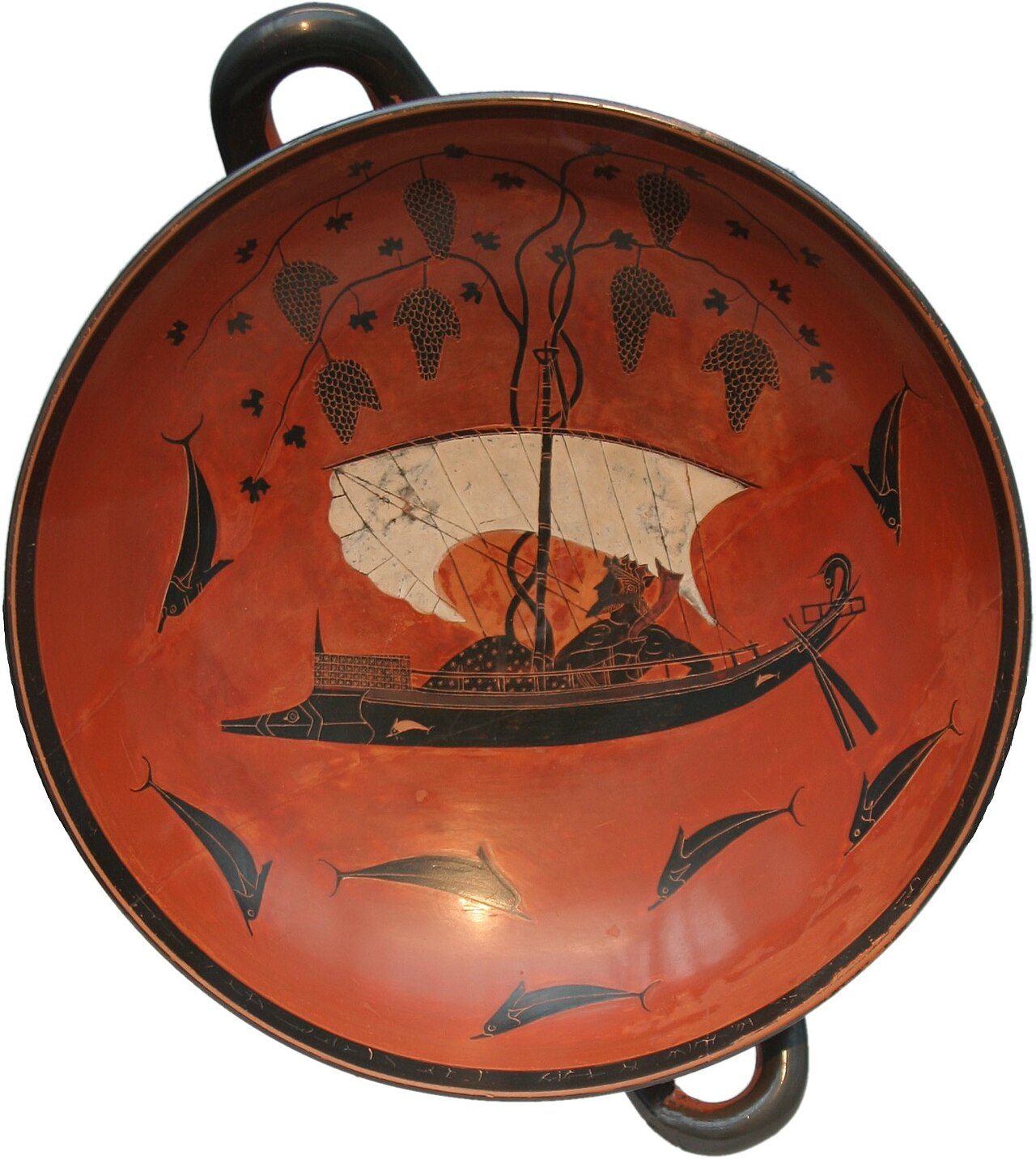

The one-line bio everyone gives him
Search "dionysus god" and the page is dominated by the same reliable cluster as most Greek mythology queries: theoi.com, Wikipedia, EBSCO's Research Starters, a Brown University course page, and a National Geographic history feature, with no commercial or single-type site crowding anything out. The capsule bio that comes back is consistent and accurate: son of Zeus and the mortal princess Semele, god of wine, festivity, ecstatic madness, and theater, worshipped with ivy crowns and a pinecone-tipped staff called the thyrsos, and known to the Romans as Bacchus.
What that capsule bio does not mention is that Dionysus was, for most of the 20th century, at the center of a real scholarly dispute over whether he belonged in the Greek pantheon to begin with, or whether he was a comparatively late arrival smuggled in from somewhere else. The dispute was not settled by a clever new reading of Homer. It was settled by a broken clay tablet dug out of the ground on Crete in 1990.
The theory that held for a century
The idea that Dionysus was an outsider god has a long academic pedigree. Erwin Rohde, in his 1910 study Psyche, proposed that the god's Urheimat, his original homeland, lay to the north, among the Thracians. Ulrich von Wilamowitz-Moellendorff, in Der Glaube der Hellenen (1932), linked him instead to Phrygia and Lydia in Anatolia, partly on the grounds that his mother's name, Semele, resembles the Phrygian word for "earth," zemelo.
The case was built on more than etymology. Scholars pointed to how rarely Dionysus is mentioned in Homer's epics compared to his later prominence, his absence from the earliest aristocratic genealogies, and a cluster of his core cult vocabulary, thyrsos, thriambos, dithyrambos, that does not have a convincing Greek or Indo-European root. The most influential piece of the case, though, came from E.R. Dodds's reading of Euripides's Bacchae, staged in Athens around 405 BC. In the play, Dionysus arrives at Thebes as a xenos, a stranger, trailing ecstatic rites from the east and forcing the city to accept him. Dodds argued that this staged "arrival" was a mythologized memory of the real, historical introduction of Dionysiac cult into Greece, and placed that introduction as late as the early Archaic period, centuries after most other Olympian cults were already established.
It was a tidy theory, and it fit a broader assumption of the time: that the ecstatic, boundary-dissolving side of Dionysiac worship, women dancing in the mountains, raw flesh torn apart by hand, sat so awkwardly next to the ordered civic religion of the polis that it had to have come from somewhere less "civilized," further north or east.
What a 1956 handbook actually said
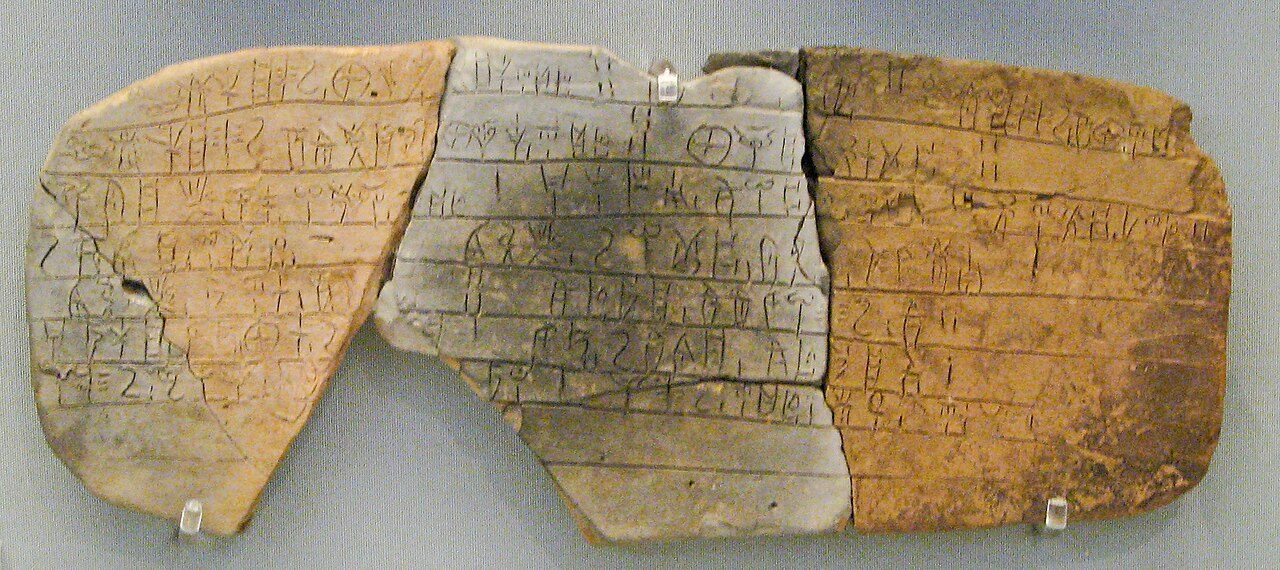
Linear B, the script used by Mycenaean Greek administrators centuries before the alphabet, was deciphered by the architect Michael Ventris in 1952 and shown to encode the earliest written form of Greek. Among the first tablets published, one small fragment from Pylos, now catalogued as Ea 102 but originally labeled Xa06, carries the word di-wo-nu-so-jo, the genitive form of "Dionysios," apparently used here as a human being's personal name rather than a reference to the god directly.
Ventris and John Chadwick, in the first edition of their landmark Documents in Mycenaean Greek (Cambridge, 1956), addressed the find directly and skeptically: "Dionysus is a surprising name to find, and there is no evidence to prove that it is divine. It only occurs once in the genitive case on a Pylos fragment." Their caution made sense on its own terms. The word appeared exactly once, on a tiny, badly damaged tablet with no surrounding religious context, in a set of records that otherwise concerned ordinary landholdings. A second, even more fragmentary Pylos tablet, Xa 1419, also carries di-wo-nu-so, but it is too damaged to establish anything beyond the word itself. For nearly forty years after decipherment, the Linear B evidence for Dionysus remained an intriguing loose end, not proof of anything.

The 1990 dig that closed the argument
In May, June, and July of 1990, Greek-Swedish excavations directed by Erik Hallager at Khania on Crete, ancient Kydonia, uncovered a room containing several inscribed Linear B tablets alongside bronze fragments, pottery, and butchered animal bone, in a destruction layer securely dated to around 1250 BC. One of those tablets, KH Gq 5, records two lines of religious offerings within what classicist Thomas G. Palaima's 1998 analysis identifies as a specific cult context: the first line records an offering of honey to the precinct of Zeus, and the second line, in the same list, records a separate offering of two amphorae of honey addressed directly to Dionysos.
Unlike the Pylos fragments, there was no ambiguity to argue over. This was an unmistakable cult offering, made to Dionysos by name, recorded in the same breath as an offering to Zeus, king of the gods himself. Palaima's own conclusion, printed at the close of his 1998 analysis, is measured but final: "No longer can we deny Dionysos a Mycenaean pedigree." The find pushed the confirmed cult worship of Dionysus back to at least 1250 BC, roughly eight and a half centuries before Euripides staged him as a foreign stranger arriving at Thebes, and it turned the older Rohde-Wilamowitz picture, of a god smuggled into Greece sometime in the historical period, into an account with no evidence left to stand on.
So why did the Greeks keep telling the arrival story?
The Khania evidence does not mean Dodds was reading Euripides carelessly, only that the "arrival" he saw dramatized should not be read as a literal historical migration. Palaima's own paper argues that historicizing a myth of arrival is unnecessary in the first place, since such stories need only reflect the ritual pattern of der kommende Gott, "the god who is always coming," a recurring epiphany in which a god who was already present gets narrated, again and again, as though newly arriving.
That leaves the older, non-Greek-sounding cult vocabulary, thyrsos, dithyrambos, and the rest, unexplained by simple borrowing. The current, more cautious position is closer to what W. Otto argued back in 1933, against the consensus of his own time: that Dionysus was already part of "Greek culture" in some form in the second millennium BC, with his most distinctive rites layered on and reinterpreted over the following thousand years rather than imported wholesale from outside.
The birth story everyone still remembers
None of this touches the part of Dionysus's story that actually circulates most widely: he is called "twice-born" because his mortal mother, Semele, was incinerated by the full sight of Zeus's divine form before she could carry him to term, and Zeus sewed the unborn child into his own thigh until he was ready to be born a second time. The god that emerged from that story took his seat, eventually, among the Twelve Olympians, though ancient Athens itself never fully agreed he belonged there over Hestia, the same kind of unresolved disagreement that runs through so much of how Greeks handled their own pantheon. He himself leads a drunken Hephaestus back to Olympus by mule in several surviving vase paintings of that scene, most famously on the François Vase, and his father, Zeus, is the one deity his own name may etymologically echo: the first half of "di-wo-nu-so" derives from the same root, *diw-, behind Zeus's own genitive form Diwos. Semele is not the only mortal mother in Zeus's family whose story is contested; the sources also disagree on how Alcmene, Heracles's mother, died.