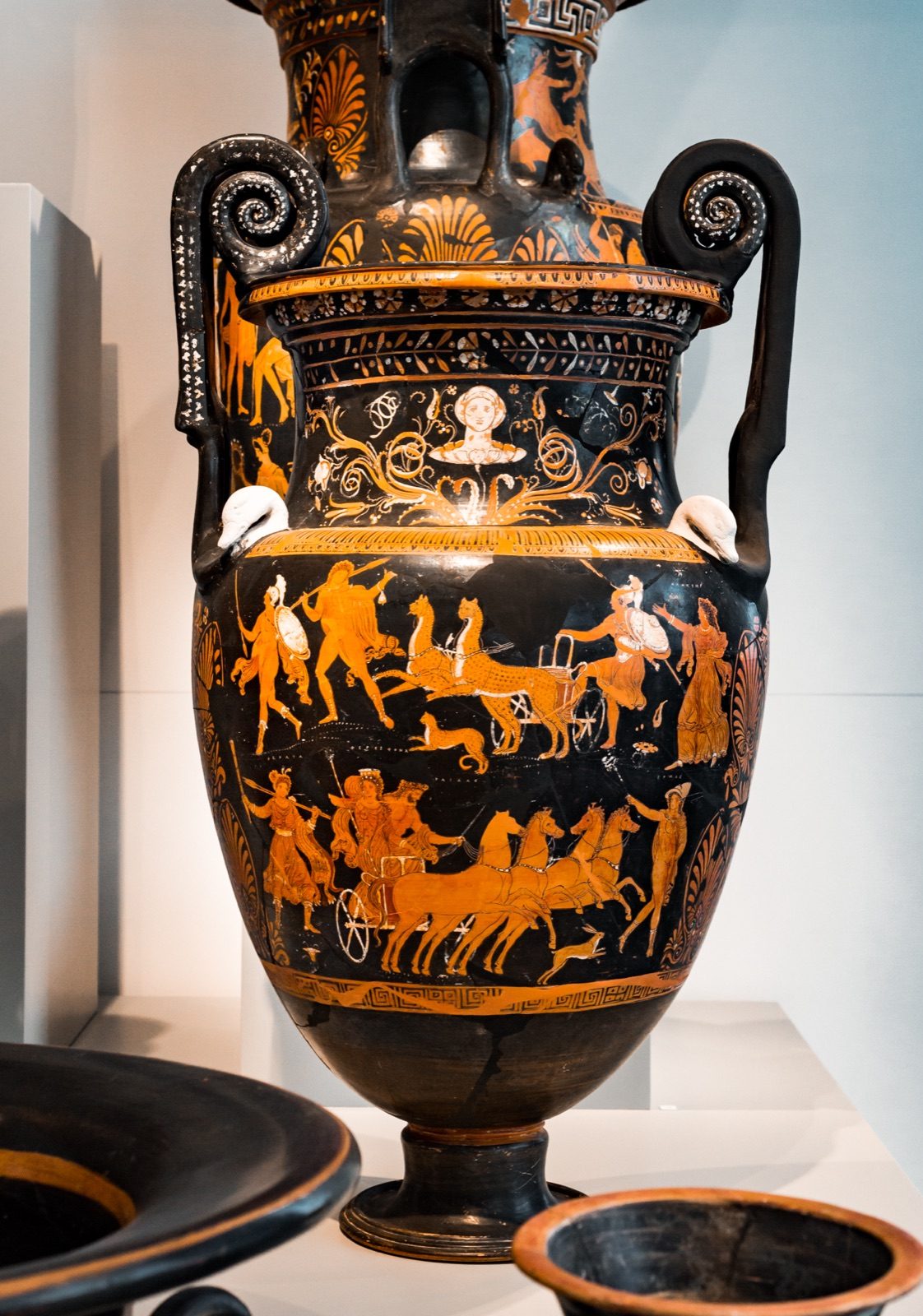

The year was never split down the middle
The story gets repeated the same way almost everywhere it's told: Hades abducts Persephone, tricks her into eating pomegranate seeds, and Zeus brokers a fifty-fifty custody arrangement, six months in the underworld as its queen and six months back on the surface with her mother, Demeter, one month for every seed she swallowed. It's tidy, it's quotable, and it isn't what the oldest surviving version of the story actually says.
That oldest version is the Homeric Hymn to Demeter, composed sometime in the 7th or 6th century BC and the most detailed account of the myth to survive from antiquity. In it, Zeus sends his mother Rhea to broker peace between Demeter, who has stopped the world's crops from growing in grief, and the rest of Olympus. The hymn records the deal Rhea brings back in a single line: Zeus "agreed that her daughter should go down for the third part of the circling year to darkness and gloom, but for the two parts should live with her mother and the other deathless gods." A third of a year is roughly four months, not six. The hymn repeats the same one-third split earlier in the text too, when Rhea first relays the terms to Demeter directly. Nowhere in the poem is the year cut evenly in half.
The seed count isn't in the source either
The other half of the popular arithmetic, one pomegranate seed per month of exile, runs into the same problem: the Homeric Hymn never gives a number. Describing the moment Hades hands Persephone the fruit before Hermes takes her back to Demeter, the hymn's narrator says only that "he on his part secretly gave her sweet pomegranate seed to eat, taking care for himself that she might not remain continually with grave, dark-robed Demeter." Persephone tells her mother the same story afterward, in the singular: "he secretly put in my mouth sweet food, a pomegranate seed, and forced me to taste against my will." No count, no six, no arithmetic that resolves neatly against a six-month sentence.
A number does eventually enter the tradition, just from a different writer working in a different country centuries later. Ovid's Metamorphoses, composed in Rome around the turn of the 1st century AD, gives Persephone seven seeds and changes how she gets them. There's no secret gift from Hades in Ovid's version. Wandering the underworld's own gardens, his Persephone "plucked, and chewed seven grains, picked from the pallid rind" herself, seen only by the nymph-born spy Ascalaphus, who then reports her to the other gods. Modern retellings borrow freely from both accounts and from folklore layered on top since, which is why the seed count drifts between four, six, and seven depending on which site is doing the retelling. None of the popular versions are actually quoting the Greek hymn, because the Greek hymn never quotes a number at all.
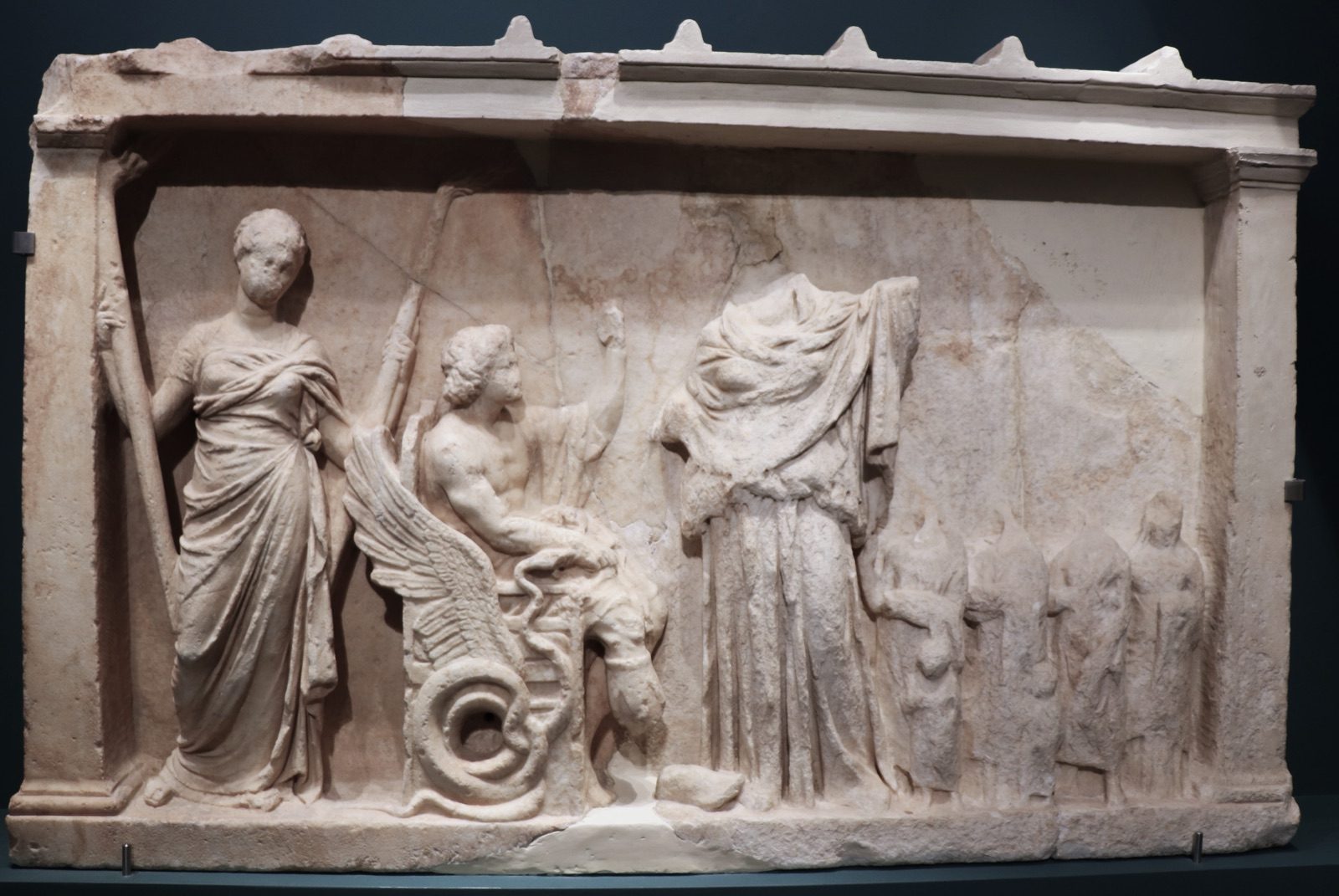

In Homer's own underworld, she gives the orders
The abduction story casts Persephone as the one being acted on, but the oldest full underworld scene in surviving Greek literature gives her the opposite role. In Book 11 of the Odyssey, Odysseus travels to the edge of the world and calls up the spirits of the dead to question them, and it's Persephone who controls who gets to appear. Describing a procession of dead noblewomen, Odysseus reports that "the women came, for august Persephone sent them forth," and a few lines later that it was "holy Persephone" who had "scattered this way and that the spirits of the women" before the shade of Agamemnon was allowed to step forward.
Hades himself is barely a character in this scene. He's named once, in passing, as a place a sacrifice is owed to, and otherwise never speaks or acts. The authority runs through Persephone instead, up to and including the power to frighten Odysseus personally: he cuts his own visit short, he says, out of fear "lest august Persephone might send forth upon me from out the house of Hades the head of the Gorgon," the same monster whose gaze turns the living to stone. The oldest known depiction of the Greek underworld puts a woman in charge of it, and gives the poem's hero more reason to fear her than anyone else he meets down there. It was also Zeus's messenger, not Hades, who got her home each spring: the hymn has Zeus dispatch Hermes to fetch her, "swift messenger from my father the Son of Cronos," and it's Hermes she credits with the news that let her leave.
What the "abduction" echoed for its first audience
The hymn doesn't soften what happens to Persephone. She's described afterward as Hades's "shy mate," "much reluctant, because she yearned for her mother," and her own account to Demeter is explicit that she was forced. But the vocabulary of a god seizing a bride and carrying her off wasn't invented for this myth alone, and ancient audiences hearing it would have recognized a version of a real marriage practice, not only a supernatural crime. Plutarch's Life of Lycurgus, written centuries later but describing much older Spartan custom, records that "for their marriages the women were carried off by force, not when they were small and unfit for wedlock, but when they were in full bloom and wholly ripe," after which a bride's-maid cut the captured woman's hair, dressed her in men's clothes, and left her alone in the dark to wait for the groom.
That doesn't make the myth a comfortable story by modern standards, and the hymn itself never asks its audience to see it that way either; Demeter's grief drives the entire plot, and it's severe enough to nearly starve every mortal on earth. What the Spartan parallel supplies is context the myth's first audiences already had and modern readers usually don't: the Greek verb used for what happens to Persephone, harpazo, meaning "to seize, to snatch away," described a real, recognized category of marriage-making in parts of the Greek world, not only its more familiar sense of violent theft.
Kore before, Persephone after, and a cult built on the switch
The mother-daughter reunion at the center of the hymn wasn't just a private family story to the Greeks who told it. Demeter and Persephone stood at the center of the Eleusinian Mysteries, an annual initiation rite held at Eleusis near Athens that ran for centuries and drew participants from across the Mediterranean, all sworn to secrecy about what actually happened inside. What survives outside that secrecy is the myth's public shape: Demeter's search for her missing daughter, the grief that stops the harvest, and the negotiated return that becomes, in the mysteries, a promise about what waits for initiates after their own deaths.
The switch in Persephone's own name tracks the switch in her role. Before the abduction, Greek sources most often call her Kore, simply "the Maiden," an identity with no separate mythology of its own beyond being Demeter's daughter. After it, she's Persephone, a name that comes attached to the underworld and to the authority the Odyssey shows her exercising there. The two names describe one figure at two different points in the same story, not two different goddesses, and Greek sources move between them depending on which half of her they're describing.