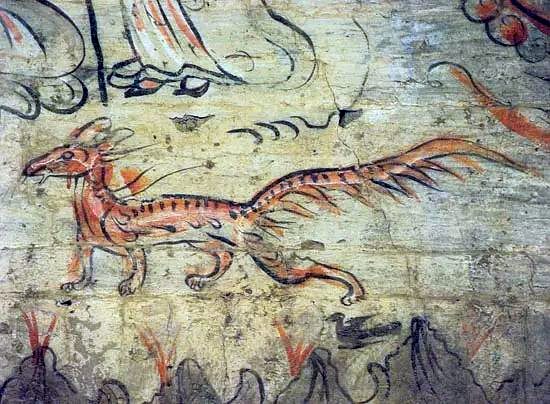

A good omen on an early tomb ceiling
On the painted ceiling of a tomb near Jiuquan, in China's Gansu province, a nine-tailed fox sits among the sun, the moon, and other signs of the heavens, part of the retinue that accompanies the immortals. The chamber, known as Dingjiazha Tomb No. 5, was painted sometime between the late 4th and mid-5th century CE, making the fox older than nearly every yaoguai story that circulates now, and it shows a nine-tailed fox working there as a good omen, not a villain. Fan wikis, gaming glossaries, and general reference sites today flatten yaoguai into a single catch-all Chinese word for "demon" or "monster." That tomb ceiling already breaks the modern shorthand: a creature now filed under "demon" was once painted onto a ceiling as a sign of favor from the heavens.
Four words that were never synonyms
Part of the confusion starts with translation. English usually renders yaoguai as one word, but the term is a compound of two characters, yao (妖) and guai (怪), that never meant quite the same thing even to the writers who used them side by side. Yao names a supernatural power that runs against the natural or cosmic order, most often the ability to take on human form; guai is broader, an umbrella covering anything strange, yao included. Two more words get folded into the same English "demon" bucket without belonging to either: gui (鬼) refers specifically to the spirits of the dead, and mo (魔) is a comparatively late arrival. English does the same flattening trick elsewhere in East Asian mythology: Egypt's Bennu, China's Fenghuang, and Slavic Zhar-ptitsa all get called "phoenix" despite sharing no common origin, and only one of them actually dies and comes back.
Mo did not exist in its current form until Buddhist translators needed a word for Māra, the tempter who tried to derail the Buddha's path to enlightenment. Early translators wrote the name with a character built from the "stone" radical, and it took an emperor to settle on the version used today: according to linguist Victor Mair's research on the term's history, Emperor Wu of Liang (r. 502-549 CE) swapped that radical for "ghost," producing the character mo still used for demon in the Judeo-Christian sense. A word can be well over a thousand years old and still be the newest member of a four-way taxonomy that never ran along a simple good-versus-evil line to begin with.
Anomalies were omens before they were monsters
The oldest surviving body of yaoguai literature is not adventure fiction. Between the Han dynasty and the Sui, a span of roughly eight centuries, Chinese writers produced thousands of short accounts of "strange" events later grouped under the name zhiguai, literally "records of anomalies." Sinologist Robert Ford Campany's 1996 study Strange Writing, the first full-length treatment of the genre in a Western language, describes how Daoist, Buddhist, and Confucian writers all used these accounts for very different arguments, but the anomalies themselves were rarely framed as enemies to be defeated. The richest surviving collection, the Soushen ji (In Search of the Supernatural), was compiled around 330-350 CE by Gan Bao, a court historian serving the Jin dynasty, and modern scholarship still calls it the oldest and most consulted example of the zhiguai genre. Many of its several hundred entries follow the same pattern: an animal is born deformed, or a fox does something uncanny, and the anomaly gets read as a portent of a dynasty's coming rise or fall. The original text did not even survive intact; the version read today is a Ming-dynasty reconstruction, and the first complete English translation, by Kenneth DeWoskin and James Crump, was not published until 1996.
A fox earned its power by age, not by malice
Fox spirits, or huli jing, are the most consistently documented yaoguai subtype across the centuries, and the earliest detailed account of how they worked has nothing to do with malice. The Xuanzhong ji, attributed to the Jin-dynasty scholar Guo Pu (276-324), sets down a staged numerology of transformation, in a widely cited English rendering of the passage: "When a fox is fifty years old, it can transform itself into a woman; when a hundred years old, it becomes a beautiful woman, or a spirit medium, or an adult man who has sexual intercourse with women... and when a fox is a thousand years old, it ascends to heaven and becomes a celestial fox." Later writers copied this same timeline for well over a millennium. The logic matches the definition of yao from earlier in this article: supernatural power gained through age and cultivation, expressed as the ability to cross into human form, not a fixed moral alignment a creature is simply born with.
Home shrines and five centuries of worship
Fox spirits also never stayed confined to the page. Historian Xiaofei Kang's 2006 study The Cult of the Fox: Power, Gender, and Popular Religion in Late Imperial and Modern China documents more than five centuries of shamanistic worship built around huli jing, with home shrines and community rituals concentrated across northern China. Imperial officials banned the cult as illicit, and the Republican and Communist governments that followed did the same, yet the practice kept surviving in private homes and neighborhood shrines outside the reach of official power. That continuity sets the fox cult apart from Norse religion's modern Ásatrú movement, which had to be rebuilt from scratch a thousand years after Iceland's conversion severed any direct line of practice; huli jing worship never had a gap to reconstruct across. Home shrines outlasted three different governments trying to stamp them out. Fan wikis file this creature under "monster"; the people who prayed to it for over five hundred years never did.
The monster-of-the-week frame is barely 500 years old
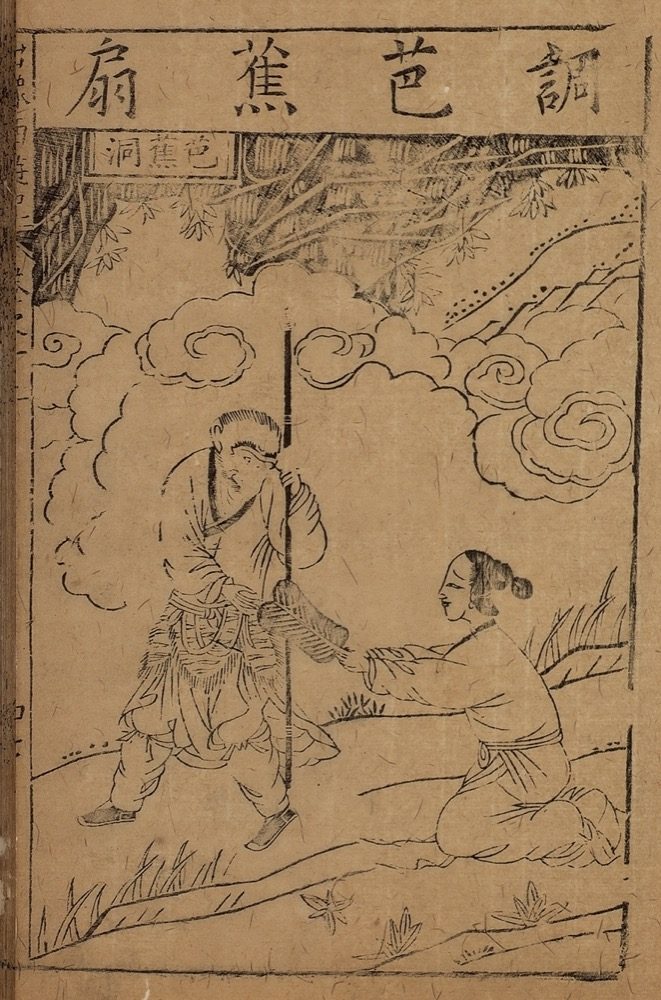
The version of yaoguai that dominates games, anime, and fan wikis today, a serial antagonist to be defeated one encounter at a time, traces to a single source: the 16th-century novel Journey to the West, attributed to Wu Cheng'en, whose earliest surviving edition was printed by the Shidetang Hall of Jinling in 1592. The novel follows the monk Tang Sanzang's pilgrimage to retrieve Buddhist scriptures, escorted by the monkey king Sun Wukong, and stocks the road with yaoguai who mostly want to capture or eat the monk. Even inside the novel the moral picture is messier than "defeat the monster": many of its yaoguai are explicitly minor immortals or cultivating animals working toward their own enlightenment, not simple villains. One of the best known, Princess Iron Fan, a rakshasi married to the Bull Demon King, wields a giant banana-leaf fan powerful enough to send Sun Wukong flying, in an episode illustrated in that same 1592 edition. That novel is roughly 1,250 years younger than Gan Bao's Soushen ji, the zhiguai collection discussed earlier in this article. The gap between those two dates is the real gap between what "yaoguai" first meant and what a search engine now assumes it means.
.jpg)