
A name people search for and can't place
"Who is Poseidon's wife" is a common enough question that it has become a fixture of mythology reference sites and quiz apps, and the answer takes one word: Amphitrite. What tends to happen next is nothing. Zeus's wife Hera has her own temples, her own myths, her own well-documented jealousy and rage. Amphitrite mostly doesn't. She shows up in family trees and Wikipedia infoboxes, gets her one line, and recedes back into being somebody's spouse.
That gap is worth taking seriously rather than treating as a modern accident of fame. The ancient sources that do name Amphitrite directly, going back to Hesiod in the 8th or 7th century BC, do not agree with each other about who her parents were, how she ended up married to Poseidon, or whether she was even always his subordinate. Pull on the thread and the tidy one-line answer, goddess of the sea, wife of Poseidon, starts to come apart into several incompatible ancient stories.
Nereid or Oceanid, depending on which page you're reading
Hesiod's Theogony, composed around the 8th or 7th century BC and the oldest surviving source to name her, is specific: Amphitrite is one of fifty daughters born to the sea god Nereus and the Oceanid Doris, listed by name alongside her sisters in a long catalogue of Nereids (lines 240 to 264). That makes her a Nereid, one rank below the Titans and Olympians in the divine hierarchy, not a member of the oldest generation of sea deities.
The 2nd-century-AD mythographer known as Pseudo-Apollodorus can't keep the story straight even within his own Bibliotheca. In one passage he lists Amphitrite among the Nereids, matching Hesiod. In another, he calls her an Oceanid instead, daughter of the Titans Oceanus and Tethys rather than of Nereus, which would put her a full generation earlier and considerably higher up the family tree. Modern reference works from Wikipedia to the Theoi Project both flag the same contradiction sitting inside a single ancient text, not a dispute between two separate authors.
Even her name resists a clean answer. One common reading breaks it into amphi- ("on both sides") and tritē ("the third," feminine), yielding something like "the surrounding third," with her son Triton's name built from the same root. But that etymology assumes the name is Greek to begin with, and other scholars treat Amphitrite and Triton as older, Pre-Greek words for the sea that Greek speakers later reinterpreted to fit their own language, the way Lake Tritonis in North Africa carries the same root without an obvious Greek meaning attached to it. Rome kept the confusion going by giving her a separate identity rather than just a translation: her Roman counterpart is Salacia, "the salty one," a distinct goddess paired with Neptune the same way Amphitrite was paired with Poseidon.
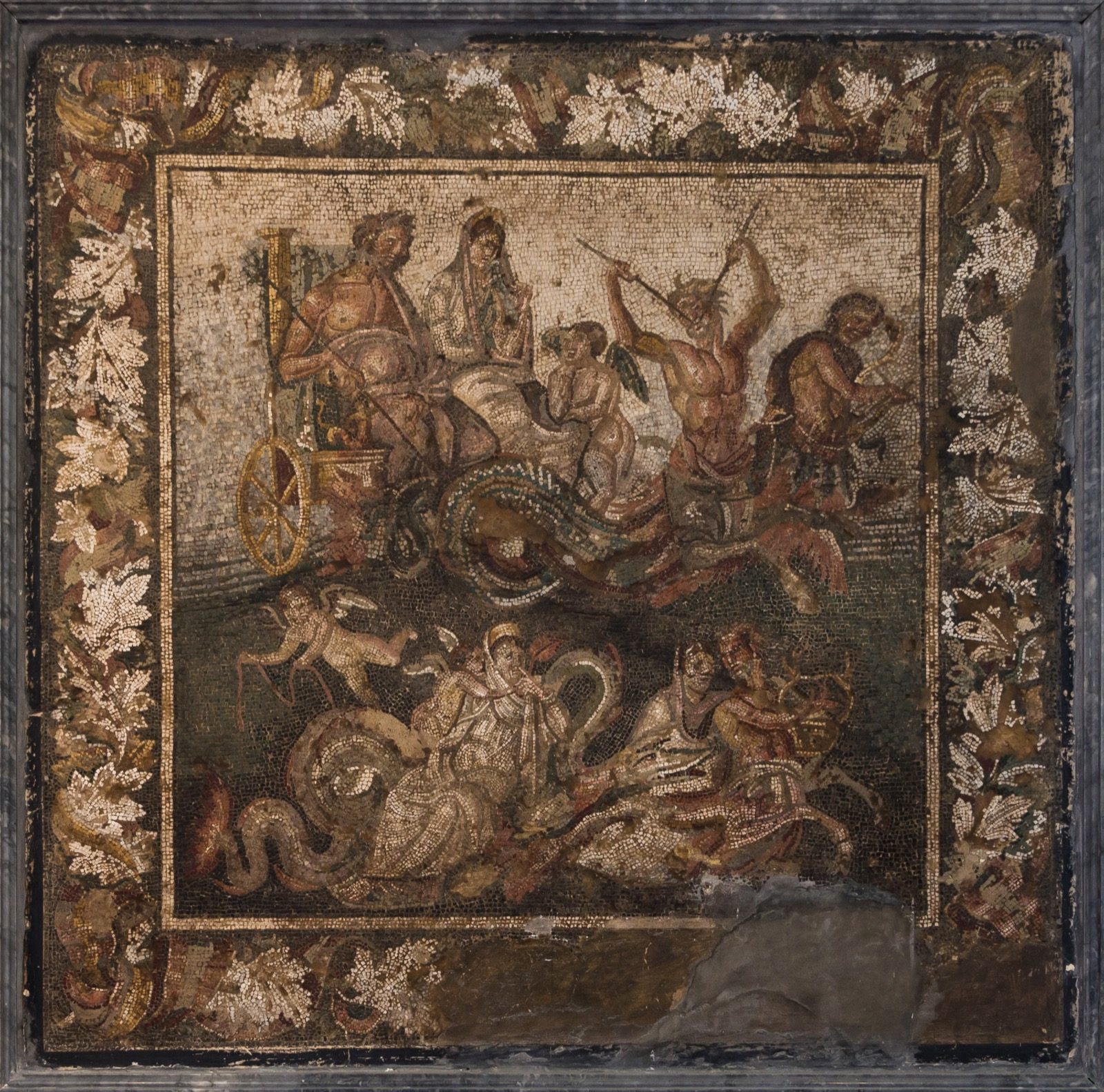
Two ancient versions of how she became his wife, and they don't agree
The most repeated version of the courtship comes down through the Hellenistic astronomer Eratosthenes and survives in the Roman writer Hyginus's Astronomica: when Poseidon wanted to marry Amphitrite, she fled to Atlas at the edge of the world to preserve her independence. Poseidon sent searchers after her, among them a dolphin, who found her, spoke on Poseidon's behalf, and talked her into the marriage. As thanks, Poseidon placed the dolphin among the stars, which is why the constellation Delphinus exists in this telling.
That is the gentle version. The 3rd-century-AD Greek poet Oppian tells the same basic chase in his Halieutica with a much harder edge: dolphins spotted Amphitrite hiding in the halls of Oceanus and told Poseidon where she was, and Poseidon, in Oppian's own words, "carried off the maiden and overcame her against her will," making her his bride and "queen of the sea" only afterward. Same characters, same dolphin informants, and a flatly different account of what happened once Poseidon found her.
A third version shows up much later still, in the 12th-century Byzantine scholar Eustathius's commentary on Homer: Poseidon simply saw Amphitrite dancing among the Nereids and took her, no flight to Atlas and no dolphin diplomacy involved. That one is roughly eighteen centuries removed from Hesiod and reflects a Byzantine scholar's own retelling rather than a source contemporary with the earlier myths, but it shows that even after two thousand years of retelling, no single version of the courtship ever fully displaced the others.
Before she was reduced to "Poseidon's wife"
In Homer, Amphitrite barely counts as a character at all. The Odyssey uses her name the way English uses "the deep": sailors dread the monsters bred "in the breeding grounds of Amphitrite," a drowned man goes down "amid Amphitrite's billows," and a coastline is battered by "the mighty billows of the Amphitrite." That's a personification thin enough to function as plain vocabulary for the sea, not a goddess with a face, a household, or lines of her own. Where Homer does treat her as a person, he shares her epithet Halosydne, "sea-born," with Thetis, another sea nymph entirely, as if the two were interchangeable rather than individuals with separate identities.
The one place she does appear among named deities in early epic is the Homeric Hymn to Delian Apollo, where she's listed among "the chiefest of the goddesses" gathered for Apollo's birth on Delos, standing alongside Dione, Rhea, and Themis, all figures from the generation before the Olympians. The classicist Jane Ellen Harrison, writing in a short 1898 note on Bacchylides for The Classical Review, read that placement as a leftover from an older layer of Greek religion. Her own conclusion, drawn from the same evidence: "the myth belongs to that early stratum of mythology when Poseidon was not yet god of the sea, or, at least, no-wise supreme there, Amphitrite and the Nereids ruled there, with their servants the Tritons. Even so late as the Iliad Amphitrite is not yet 'Neptuni uxor' [Neptune's wife]." On that reading, "Poseidon's wife" isn't Amphitrite's original role. It's the title that survived after an earlier, more independent sea goddess got folded into his household.
The one surviving myth where Amphitrite gets to act rather than just be described comes from the poet Bacchylides, writing in the 5th century BC. When the hero Theseus dives into the sea to prove he's really Poseidon's son, he surfaces inside an underwater palace and finds "his father's dear wife, august, ox-eyed Amphitrite," who wraps him in a purple cloak and crowns him with the wedding garland Aphrodite had given her at her own marriage to Poseidon. The travel writer Pausanias, writing centuries later, has Theseus surface with a gold crown from Amphitrite instead of a garland, while the Roman writer Hyginus records a rival version in which that same crown belongs to a different sea nymph, Thetis, also received as a wedding gift from Aphrodite. The gift keeps moving between the two women depending on which author is telling the story, but for one scene, at least, Amphitrite is the one doing the giving instead of just being named as somebody's wife.
A statue next to his, never a temple of her own
The 2nd-century-AD travel writer Pausanias recorded Amphitrite's image standing beside Poseidon's again and again on his tour of Greece: a gold-and-ivory statue of the pair riding a chariot inside Poseidon's temple at the Isthmus of Corinth, a relief carving of the two of them on the altar of Apollo at Amyklai, votive statues of Amphitrite, Poseidon, and Hestia together at Olympia, and reliefs of the couple worked into the throne of Zeus's own cult statue, also at Olympia.
What's consistent across every one of those descriptions is that Amphitrite never appears alone. She's always framed as Poseidon's attribute, present because he's present, rather than as a goddess with a shrine, priesthood, or festival calendar of her own the way Athena had. Poseidon is one of the Twelve Olympians with sanctuaries across the Greek world, and the pairing inside those sanctuaries is still cited as evidence Amphitrite mattered to how he was worshipped, even without her ever accumulating an independent cult of her own.
The single most repeated image of her, the one on the Pompeii mosaic above, is the wedding chariot: the couple riding together across the waves behind hippocamps or other sea creatures, common enough on mosaics and vase paintings that ancient writers could reference it without explaining it. The 3rd-century-BC poet Apollonius Rhodius builds a whole scene around that assumption in the Argonautica. When a horse leaps out of the sea in front of the stranded Argonauts, the hero Peleus reads it as a sign, reasoning aloud that "Poseidon's loving wife has just unyoked his team," as if Amphitrite's chariot were the most ordinary explanation available for a horse appearing out of nowhere.
The son every source agrees on, the daughter they argue over
Triton, the merman herald of the sea, is the one child ancient sources don't dispute. Hesiod's Theogony names Amphitrite and "the loud-roaring Earth-Shaker" as his parents directly, and Apollodorus and Hyginus repeat the same pairing without variation.
Rhode, the nymph the island of Rhodes is named for, is a different story. Apollodorus makes her Poseidon and Amphitrite's daughter too. But the 1st-century-BC historian Diodorus Siculus gives her an entirely different mother: Halia, sister of the Telchines, with no Amphitrite involved at all. A third, thinner tradition names Aphrodite instead. One island, one namesake nymph, and three ancient authors who can't settle on who her mother was, which is a smaller-scale version of the same pattern that runs through everything else attached to Amphitrite's name.