
The five-symbol list skips the strangest fact
Pausanias reached Hermione, on the eastern edge of the Argolid, sometime around AD 175, cataloguing local sanctuaries the way he did across the rest of Greece. When he got to the temple of Hestia, there was no statue waiting inside, no cult image of any kind. Just an altar. For a goddess usually summed up in a short list of household objects, that is an odd fact to lead with. It is also one of the better-attested things ancient writers actually said about how she was worshipped.
The familiar shortlist, hearth, flame, sometimes a kettle, sometimes a flowered branch, is not wrong. It describes what happened on the rare occasions Hestia was depicted at all. What it leaves out is the far more common ancient practice: an actual fire, kept burning, standing in for her instead of any image.
Pausanias found an altar, not a statue
That line, "no image, but only an altar," is Pausanias's own description of Hestia's sanctuary at Hermione, recorded in his Description of Greece 2.35.1: "we see no image, but only an altar, and they sacrifice to Hestia upon it." He adds that maidens and widows about to remarry customarily sacrificed there before their weddings, a detail he records without further comment, the way he often notes local cult practice without editorializing on its meaning.
Hermione's temple is also unusual simply for existing. Pausanias and other ancient sources treat freestanding temples to Hestia as rare, not because she was neglected but because, as later commentators summarizing this pattern put it, every hearth was already sacred to her. A dedicated building was almost redundant when the goddess was already present in every home's fire.
Every city hall was already her temple
Where Hestia did get consistent, formal honor was the prytaneion, the public hall that functioned as a Greek city-state's administrative center and kept a communal hearth burning at its heart. Every prytaneion counted as a sanctuary of Hestia by default, its fire standing in for the goddess herself rather than any statue placed inside it. Pindar's Nemean Ode 11 addresses her directly as "guardian of parliaments," and a fragment of Bacchylides invokes her as the goddess of the public hearth at Larissa, sitting "in mid-city by the fragrant Peneios," language that treats her presence as geographic and civic rather than sculptural.
This is also where the household version of her worship scaled up. The same domestic hearth central to Hestia's role as goddess of home and family, kept burning and treated as sacred, was mirrored at the level of the whole city, with the prytaneion's flame read as a symbol of the community's continuity. Losing that fire, or a colony carrying an ember from its mother city's hearth to light its own, were not incidental details; they were treated as meaningful acts precisely because the fire itself, not an image of Hestia, was doing the religious work.
When she was depicted at all: a veil, a kettle, maybe a branch
Hestia was not never depicted, only rarely, and the two traditions that do exist come from different eras and different media. In Athenian vase painting, she appears as a modestly veiled woman, occasionally holding a flowered branch that may represent the chaste tree. One well-documented example is the drinking cup made by the potter Sosias and decorated by the Sosias Painter around 500 BC, now in Berlin's Antikensammlung, where Hestia sits veiled among the gods on a scene showing Heracles's introduction to Olympus, seated on a stool draped with leopard skin alongside Zeus, Hera, and Dionysus.
In classical sculpture, when she appears there at all, her attribute shifts to a kettle rather than a branch. The two conventions were never merged into one settled iconography the way Zeus's thunderbolt or Poseidon's trident became fixed early and stayed fixed. Hestia's visual identity stayed comparatively unresolved across centuries of Greek art, which fits a goddess whose primary form of worship bypassed images in the first place.
The most famous "Hestia" statue might not be her
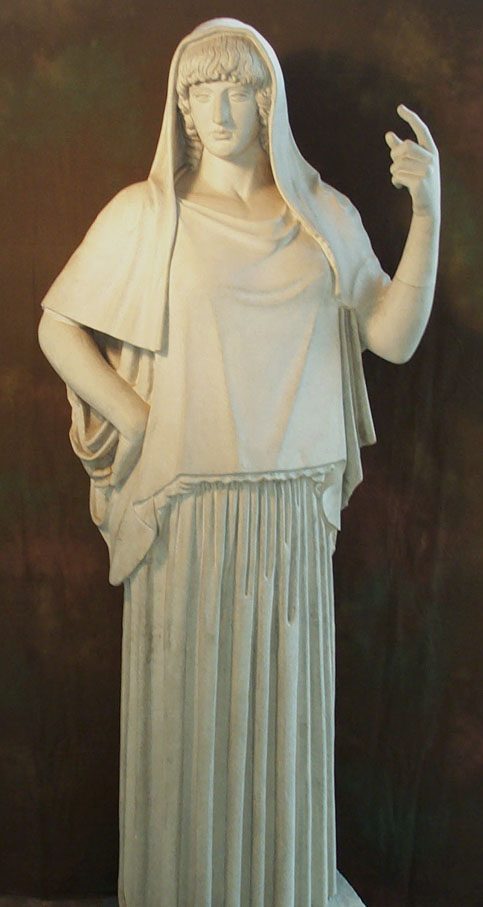
The best-known marble now associated with Hestia is the so-called Giustiniani Hestia, a finely carved statue now in Rome's Torlonia Collection, likely a Hadrianic-era Roman copy of an Early Classical Greek bronze from around 470 BC. It is the only known bronze of that early period reproduced at full scale in marble for a Roman collection, which alone made it a prized piece once it entered the Giustiniani family's holdings in Palazzo Giustiniani by the early 1630s.
What the statue was not called, at least not at first, is telling. The earliest surviving Giustiniani inventory, from 1638, describes it plainly as a "vergine vestale vestita, di marmo greco tutta antica," a clothed Vestal Virgin of ancient Greek marble. The identification with Hestia herself came later, through later collectors and scholars rather than the statue's own original context. Contemporary classical scholarship, working from the same literary tradition of imageless Hestia sanctuaries described above, remains unconvinced the identification is even correct, with Demeter and Hera proposed as alternative candidates for who the veiled, peplos-draped figure actually represents.
The throne she never actually gave up
A common explanation for why Hestia recedes from later mythology is that she voluntarily surrendered her seat among the Twelve Olympians to Dionysus when he arrived on Olympus looking for a place among the gods, and Hera pointed out that the twelve thrones were already spoken for. It is a tidy story, and it shows up constantly in modern retellings and quiz sites. It also has no ancient source.
The earliest known appearance of the Hestia-Dionysus throne story is Robert Graves's The Greek Myths, published in 1955. Wikipedia's entry on that book notes plainly that Graves's interpretive theories and etymologies "are rejected by most classical scholars," a reputation built on his practice of filling gaps in the ancient record with his own invented detail when no source existed. There was also never a single, fixed roster of Twelve Olympian thrones in actual Greek religious practice, membership varied by city and period, which undercuts the very premise of a seat being formally surrendered in the first place.
Plato thought her name meant "being" itself
Plato's Cratylus, a dialogue on the origin of words, has Socrates propose an etymology for Hestia's name: that it derives from ousia, the Greek word for essence or reality, or its older form essia. Plato was constructing folk etymology rather than historical linguistics, but the impulse behind it fits everything else about her. Ancient Greeks approached Hestia less as a personality with a backstory and more as a condition, present or absent, the flame is lit or it is not, the household or city holds together or it doesn't.
That framing helps explain why a five-item symbol list undersells her. Zeus needed a thunderbolt because he acted in the world through it. Hestia's most consistent ancient "symbol" was never really an object she carried. It was a fire that, by design, required no image standing next to it to do its work. Not every Olympian's iconography stays this unresolved, but plenty do: Ares' own symbol, the ♂ glyph now used for Mars and for male sex, has two fully documented, competing origin stories, a Byzantine shield-and-spear reading against a 1962 Greek-letter-abbreviation theory, and historians haven't settled which one is correct either. That same pattern, an attribute whose origin ancient sources never fully settled, reaches Achilles too: Homer's Iliad ends before Achilles dies, and which wound actually killed him rests on a translation mix-up between two different ankle and heel bones that's been repeated for centuries.