A minor spirit with two competing origin stories
Aletheia, from the Greek word for truth, was a daimona, a personified spirit, not one of the twelve Olympians. She belongs instead to a much larger cast of minor figures that surviving Greek sources catalog alongside the major Greek goddesses most people can name. The Theoi Project's compiled classical sources list her opposite numbers as Dolos (Trickery), Apate (Deception), and the Pseudologoi (Lies), a lineup that makes her purpose clear: she stood for a moral contrast, not for a myth cycle of her own. The poet Pindar names her parentage twice. In Olympian Ode 10, written in 476 BC for the boxer Hagesidamus of Western Locri, he writes: "Ah Moisa (Muse), I beg you, and Alatheia (Truth) daughter of Zeus, with your right hand upraised shield me from this reproach of a pledge broken and a friend's dues dishonoured," in Geoffrey Conway's translation. A surviving fragment repeats the claim: "Alatheia (Truth), who art the beginning of great virtue, keep my good-faith from stumbling against rough falsehood," translated by John Sandys. The lyric poet Bacchylides, working around the same period, describes her standing apart from mortal life entirely: "Alatheia (Truth) is from the same city as the gods; she alone lives with the gods."
A second tradition disagrees with Pindar on where she came from, and gives her an origin built out of clay, not blood.
The forger who ran out of clay
That second story survives only in Latin, as a fable attributed to Aesop and preserved through the Phaedrus Appendix. It opens with Prometheus working as a potter, tasked with shaping the newest generation of humanity, who "decided one day to sculpt the form of Veritas, using all his skill so that she would be able to regulate people's behaviour." Veritas is the Latin name the fable uses throughout for Aletheia. Partway through the work, Jupiter, the Roman name for Zeus, summoned Prometheus away, and he left the workshop in the care of a recent apprentice named Dolus, personified Trickery. Dolus spent the time secretly building a second statue, identical to the first in every visible feature, copying it so closely that he ran out of clay for its feet before Prometheus returned.
Both statues were fired in the same kiln and given life together. "Sacred Veritas walked with measured steps, while her unfinished twin stood stuck in her tracks," the fable says. The counterfeit acquired the name Mendacium, or Pseudologos, Falsehood. The story closes on its own moral: a falsehood "can start off successfully," but given time, "Veritas is sure to prevail." A lie with no legs to stand on traces back to this specific, datable text, not to a vague folk metaphor with no traceable source.
A shorter, separate fable about Aletheia survives through the later compiler Babrius. A traveler finds Veritas living alone in the wilderness and asks why she has left the company of other people. She answers that lies were once rare "among the people of old" but "have now spread throughout all of human society." This fable, too, exists only in a Latin text, with Veritas standing in for the Greek Aletheia.
A goddess placed at a real oracle
Outside these fables, evidence for Aletheia as an object of cult worship or visual art is thin, but one description survives from the Greek rhetorician Philostratus the Elder, writing in the 3rd century AD. In his Imagines, a collection describing paintings he claims to have seen, Philostratus recounts a scene set at the sanctuary of Amphiaraos in Oropos, a real dream-oracle on the border of Attica and Boeotia where visitors slept inside the sanctuary hoping for a prophetic dream. "Aletheia clad all in white is there and the gate of dreams," he writes, "for those who consult the oracle must sleep," and Oneiros, the god of dreams, appears nearby carrying a horn, "showing that he brings up his dreams through the gate of truth."
The horn is a specific detail, not decoration. It echoes a passage in Homer's Odyssey describing two gates for dreams: one of ivory, through which false dreams pass, and one of horn, through which true dreams pass. Placing Aletheia at the gate of horn ties the abstract idea of truth to a piece of dream lore that Greek audiences would already have recognized from Homer, and it is one of the only surviving records that puts the goddess inside a specific, named, physically real religious site, not just inside a poem or a fable.
Truth, daughter of time
Rome gave Aletheia a new name, Veritas, and attached her to a saying that outlived both the goddess and most of the writers who repeated it. The 2nd-century AD writer Aulus Gellius records it in his Attic Nights, Book 12, Chapter 11, right after quoting a couplet he attributes to Sophocles: "See to it lest you try aught to conceal; Time sees and hears all, and will all reveal." Gellius then adds: "Another one of the old poets, whose name has escaped my memory at present, called Truth the daughter of Time." Even the writer who preserved the line for posterity could not identify who first wrote it.
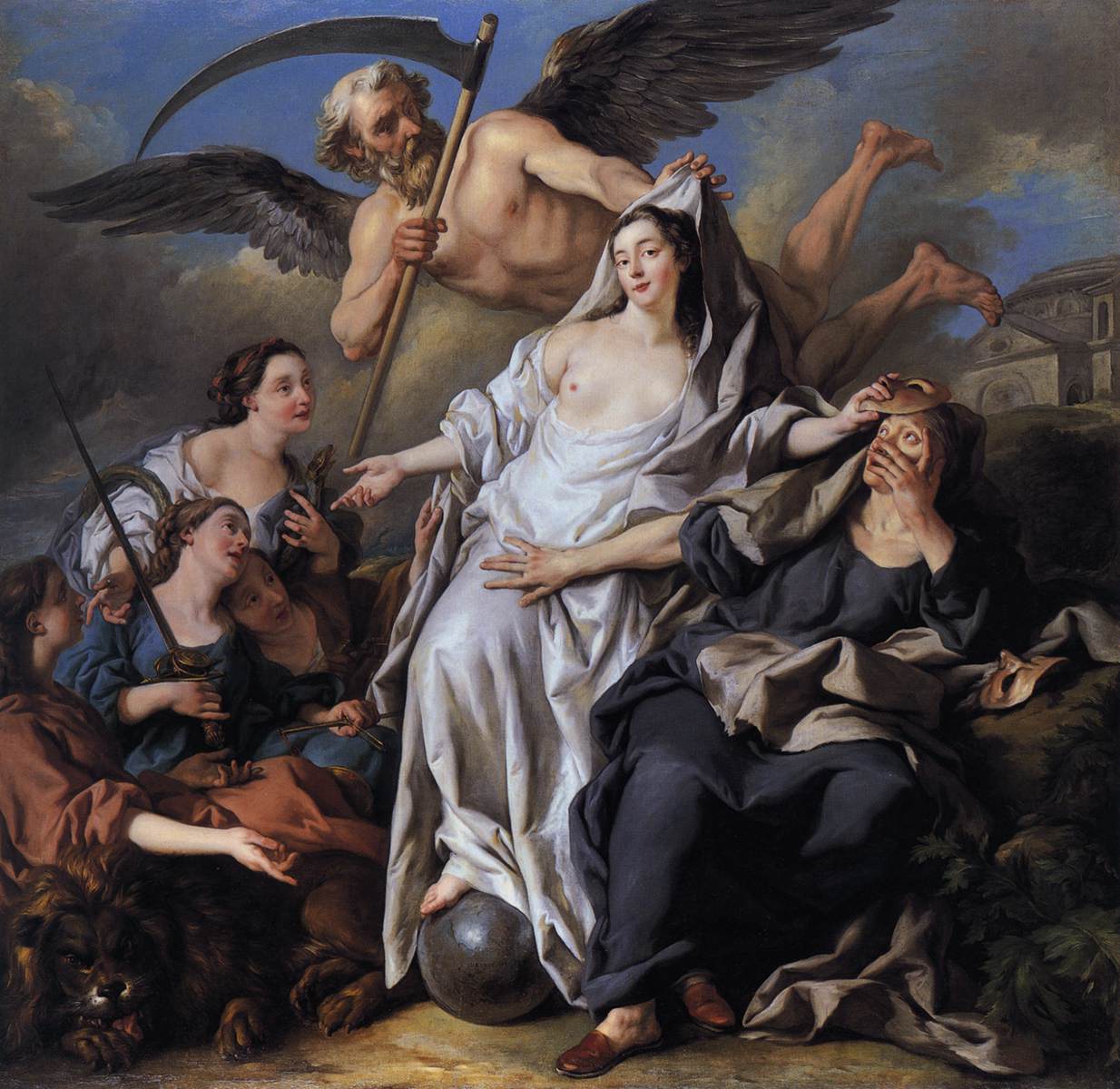
The idea kept circulating through later Latin and Byzantine writers before Renaissance painters turned it into a standing subject known as Veritas filia Temporis, Time Unveiling Truth: a winged figure of Time lifting a veil from a female figure of Truth. Painters including Annibale Carracci and Jean-François de Troy produced versions of the scene; the header image on this page, de Troy's 1733 painting, is one of them. Centuries later, the philosopher Francis Bacon restated the same idea in Novum Organum, writing that "rightly is truth called the daughter of time, not of authority."
The same word did separate work in philosophy, twice
Long before these fables were written down, the word aletheia was already doing unrelated work as a philosophical term. Around the 5th century BC, the philosopher Parmenides used it as the title of one half of his poem On Nature, contrasting the Way of Truth (aletheia) with the Way of Opinion (doxa). That distinction, between what genuinely is and what merely seems to be, became one of the founding moves of Western metaphysics, and it has no connection to Pindar's daughter-of-Zeus or Prometheus's forged statue.
The word also carried religious weight outside Greek myth entirely. The Septuagint, the Greek translation of Hebrew scripture, uses aletheia to render the Hebrew words emet and emunah, and the Gospel of John uses the same word repeatedly in connection with Jesus's teaching, giving it a spiritual sense closer to divine reality than to plain factual accuracy.
About 2,400 years after Parmenides, the German philosopher Martin Heidegger revived aletheia again, beginning in his 1927 book Being and Time and continuing through Introduction to Metaphysics. He argued the word should be understood as Unverborgenheit, unconcealment, the way something first becomes intelligible at all, not a simple match between a sentence and a fact. Decades later, in print, he corrected his own earlier phrasing: calling aletheia "truth" in the ordinary sense, he wrote, had been inadequate and misleading.