
A pantheon built to justify one throne
Inca religion was not a loose collection of nature gods worshipped for their own sake. It was structured, deliberately, around a political claim. The Sapa Inca, the empire's ruler, was called Intip churin, "son of the sun," and the Inca state treated that lineage as literal fact rather than honorific title. If the emperor really was the sun god's child, obeying him stopped being a purely political matter and became a religious obligation. The high priest of the sun cult, the Willaq Umu, ranked as the second most powerful person in the empire and was typically the Sapa Inca's own brother, which kept the machinery of worship inside the same family that held the throne.
That arrangement shaped which gods mattered most in daily imperial life. Viracocha outranked everyone in the origin myths as the creator of the universe itself, but Inti, tied directly to the ruling family's legitimacy, received the empire's heaviest institutional investment: dedicated land, herds, temples, and a full priesthood in every conquered province. Pachamama, the earth, answered a different need entirely, one that had nothing to do with palace politics and everything to do with whether crops survived the season. All three, plus Inti's sister and consort Mama Quilla, the moon, and Illapa, the god of thunder and rain, filled out a pantheon of gods organized less like a family tree and more like an institution with defined jobs to do.
Viracocha: the creator who left and never came back
Viracocha, whose fuller ceremonial name is recorded as Apu Qun Tiqsi Wiraqutra, was the creator and supreme deity in Andean mythology, predating the Inca state itself. According to the myth recorded by the 16th-century chronicler Juan de Betanzos, Viracocha rose out of Lake Titicaca during an age of darkness to bring the world into being. He shaped the earth and sky, then carved a race of giants out of stone; displeased with what he'd made, he turned some back to stone and drowned the rest in a flood. Afterward he made the sun and moon rise from the lake and, at nearby Tiwanaku, formed humans and animals out of clay.
The myths don't stop with creation. Viracocha is described walking across the ancient world teaching people the arts of civilization, then departing westward across the Pacific from the coast near Manta, in what is now Ecuador, promising he would return one day. Some sources put him, not Inti, at the center of the Gateway of the Sun carving at Tiwanaku; others treat the sun itself as just one item on Viracocha's long list of creations, so the two gods blur together instead of staying clearly ranked. Even the imperial genealogy that Inti's cult depended on wasn't settled: one surviving legend names Manco Cápac, the mythical founder of the Inca line, as the son of Inti, while a separate tradition names him the son of Viracocha instead. Inca religious memory, preserved almost entirely through colonial-era Spanish transcription, kept more than one answer to the same question, with no native written record left to settle it.
Inti: a golden idol built from a dead king's ashes
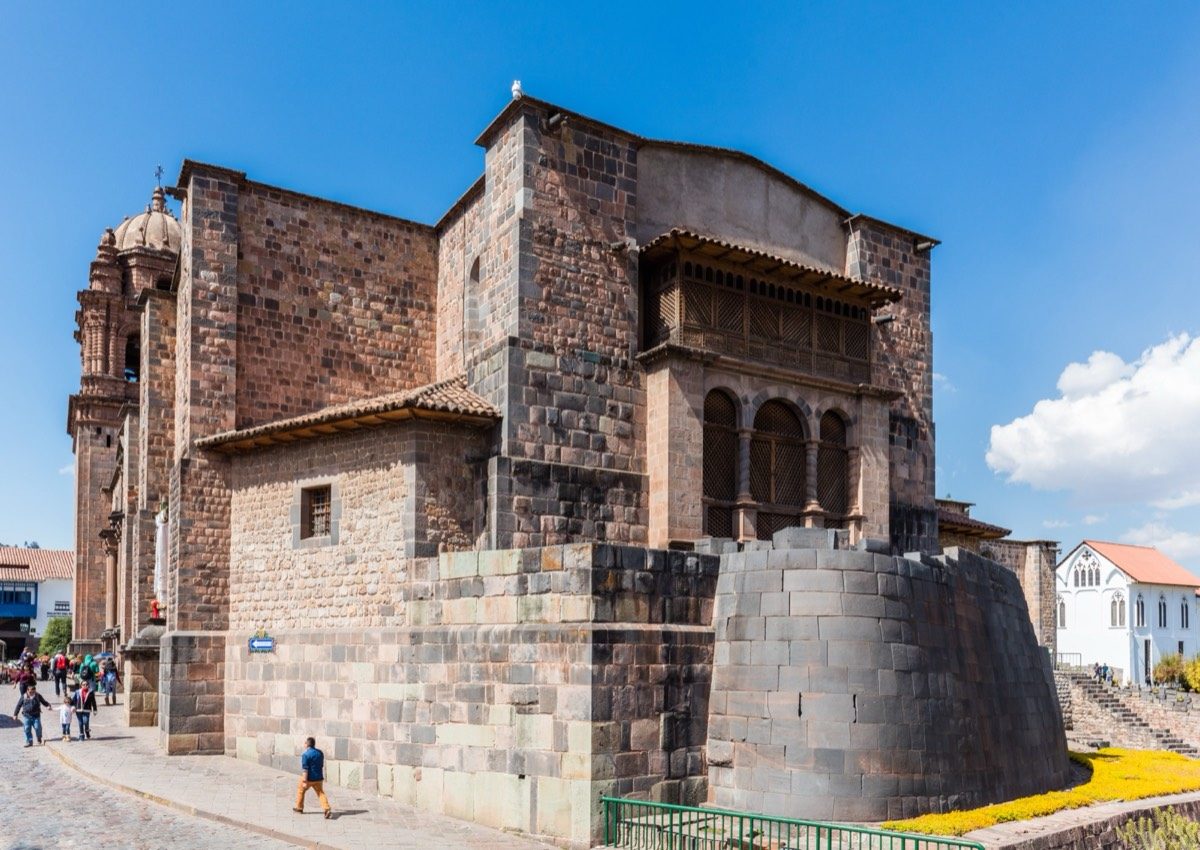
Inti's cult ran on real institutional weight. Roughly a third of every conquered province's land and herds was set aside for his worship, funding a temple staffed by priests and mamakuna, women selected from the aqllakuna ("chosen women") who wove ceremonial cloth and brewed chicha for his festivals. The empire's central shrine to him was the Qorikancha in Cusco, the chief temple of the Inca state religion, its walls once lined with gold sheeting and niches displaying the mummified bodies of past emperors.
The most striking object tied to his worship was the Punchao, a golden idol representing Inti, typically described as a seated boy figure, its torso hollowed out and filled with a mixture of gold dust and the burned, ground remains of deceased Inca kings' hearts. Inca priests hid the Punchao when Spanish forces first reached Cusco in the 1530s. It resurfaced in Spanish hands around 1572, the same year colonial authorities executed Túpac Amaru, the last ruler of the rump Inca state at Vilcabamba, and then it disappears from the historical record entirely. Most historians treat it as almost certainly melted down for bullion, one more piece of Inca religious material culture converted into Spanish coin rather than preserved.

Pachamama: the goddess who outlasted the empire
Pachamama, Mother Earth, held a position no Spanish conquest ever managed to erase. As a fertility and protector deity tied to space, time, and the land itself, she promoted good harvests and safeguarded fields and livestock, concerns that mattered to Andean farmers regardless of who sat on the imperial throne in Cusco. One version of Inca myth even folds her into Inti's own family twice over, naming her both his mother by the sky god and, in the same account, his second wife, a contradiction the sources never bother to resolve.
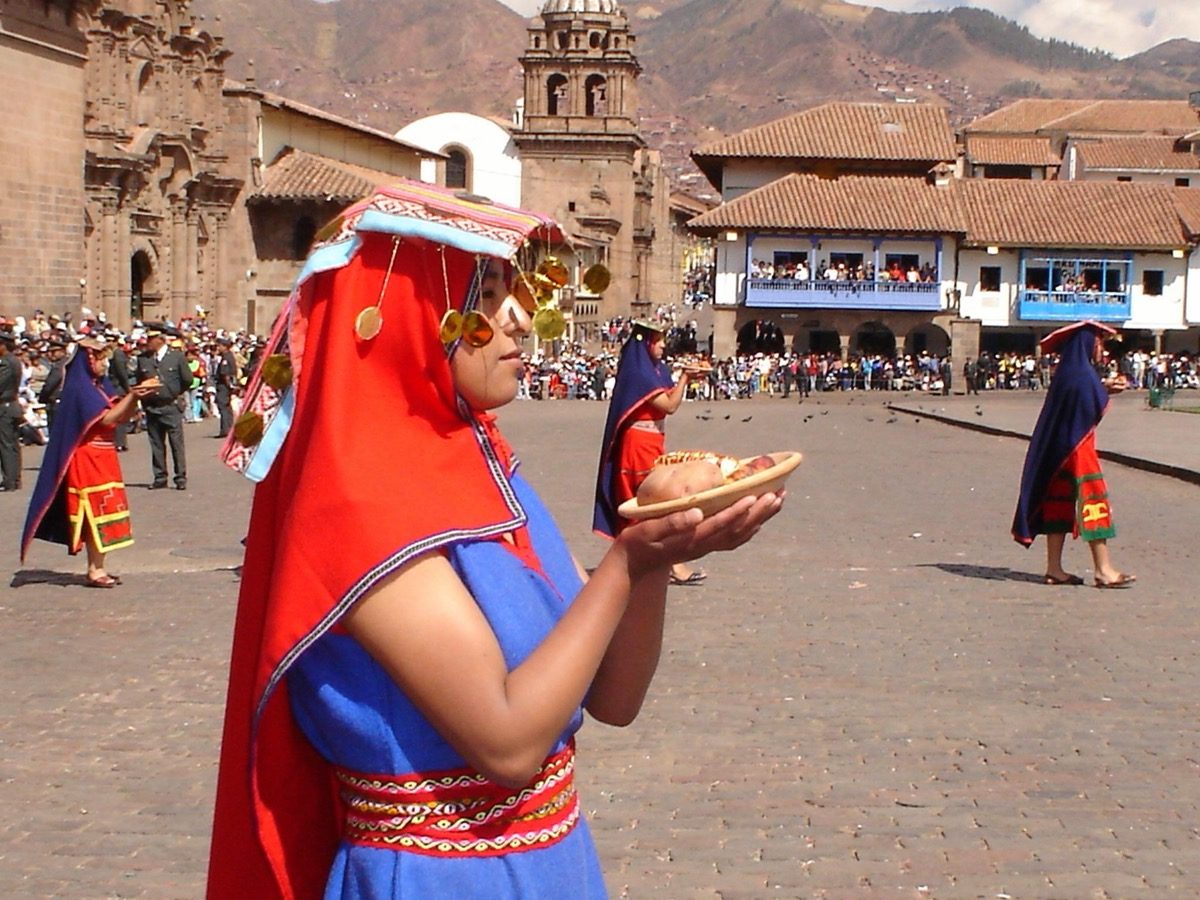
Pachamama worship never stopped. She's still actively honored across the Andes, most visibly around August 1, the start of Pachamama Raymi, when communities in Peru, Bolivia, and Ecuador make offerings, called challa, of coca leaves, chicha, and food buried or poured into the earth. In colonial-era Bolivia, particularly around Copacabana on Lake Titicaca, Andean communities and artists blended her identity with the Catholic Virgin Mary. Scholarship on the region describes this partly as a conversion tool Spanish priests found convenient and partly as a form of quiet resistance: indigenous artists folded Pachamama's presence into Marian imagery specifically to keep venerating her under cover of an approved Catholic cult, sometimes literally shaping the Virgin's robes in colonial paintings to echo the silhouette of a sacred local mountain.
The festival Spain banned and Peru rebuilt from a chronicle
Inti Raymi, the winter solstice festival honoring Inti, was created during the reign of Pachacuti, the ninth Sapa Inca (r. 1438-1471), according to the chronicler Inca Garcilaso de la Vega. Held every June 24 in Cusco's main square, the Haukaypata, it marked the Inca new year and the point in the Andean winter when daylight began lengthening again. According to the eyewitness account of Spanish priest Cristóbal de Molina, the last Inti Raymi held with a reigning Sapa Inca present took place in 1535, under Manco Inca, who by then ruled only as a Spanish-installed puppet monarch and, lacking access to the ceremony's traditional gold implements, is said to have used an ordinary plow. Manco Inca led a full-scale rebellion against Spanish rule the following year.
What followed was not a gradual fading out. Spanish colonial authorities banned Inti Raymi along with other Inca religious practice after the conquest, and Viceroy Francisco de Toledo, whose eleven-year administration (1569-1581) also carried out the execution of Túpac Amaru, enforced a harsher, more systematic crackdown on indigenous ceremony and even traditional dress as part of his broader colonial reforms. The festival survived only underground after that, kept alive quietly within Andean communities for roughly four centuries. It reentered public life in 1944, when Cusco's Instituto Americano de Arte, led by the historian Humberto Vidal Unda, organized a public reconstruction built largely on Garcilaso de la Vega's chronicle account of the original ceremony. Writer and actor Faustino Espinoza Navarro wrote the script, entirely in Cusco Quechua, and played the role of the Inca himself for the first fourteen years of the revived festival. Since then, an annual staged version has run every June 24 at Sacsayhuaman, now recognized as one of South America's largest festivals and drawing thousands of visitors, a modern reenactment standing in for a chain of practice that Spain had actually managed to break.
A landscape of 328 shrines, not a list of names
Inca religious geography extended well past a short list of named gods. Cusco's ceque system organized 328 huacas, sacred sites that could be a rock outcrop, a spring, a mountain ridge, or a constructed shrine, along 42 conceptual lines called ceques radiating outward from the Qorikancha. Kin groups called ayllu were each responsible for maintaining the huacas along their assigned ceque and making regular offerings there. Archaeologist Brian Bauer's field survey of the system, conducted from 1990 to 1995 and published as The Sacred Landscape of the Inca: The Cusco Ceque System, remains the standard academic account of how the network was organized and what it likely coordinated: land tenure, kinship obligations, and a calendar tracked partly through astronomical alignments built into the shrine network itself.
That structure is a reminder that "Inca gods" undersells what Inca religion actually was. Naming Viracocha, Inti, and Pachamama answers the question search engines usually ask, but the Inca themselves distributed sacred meaning across an entire physical landscape, not just a pantheon of personified figures. Other Andean societies did something structurally similar with reconstructed tradition: the Aztec pantheon most people encounter today was reorganized under a 15th-century ruler who had older records burned, and Norse mythology survives mainly through a 13th-century Christian writer's retelling set down two centuries after Iceland's conversion. Inti Raymi's 1944 reconstruction fits the same pattern the site keeps running into: what gets called "ancient tradition" is very often a later, documented act of rebuilding, not an unbroken line back to the source. The Maya gods show the same gap from another angle: one letter still stands in for a name.