A search that lands on someone else's peace first
Search "goddess of peace" today and a fair share of results will not point toward Mount Olympus at all. In Catholic devotion, "Our Lady, Queen of Peace," Regina Pacis in Latin, is a title for the Virgin Mary that Pope Benedict XV pushed into wider use during the First World War, commissioning a devotional statue as an appeal to end the fighting. That title is still active: parishes around the world carry the name, and the feast associated with it is marked every year. It is a real, well-documented tradition, and it has nothing to do with the older figure this article is about.
The older figure is Eirene, a goddess who predates Christianity by centuries and who Greek writers treated as a specific person with a specific family, not a general virtue given a name. She has a father, sisters, a cult history with real dates attached, and a sculptural tradition that survives in museums today. None of that shows up if the search engine assumes you mean the modern devotional title instead.
One of three sisters who kept the world in order
Hesiod's Theogony, composed around 700 BC, is explicit about where Eirene comes from. Zeus, it says, "married bright Themis who bare the Horae (Hours), and Eunomia (Order), Dike (Justice), and blooming Eirene (Peace), who mind the works of mortal men" (trans. Hugh G. Evelyn-White, Theogony 901-903). Themis was one of the twelve Titans, Gaia and Uranus's children from the generation before the Olympians, and her role as the personification of divine law and custom carries directly into her daughters' names: Order, Justice, and Peace are not three unrelated blessings. They are three faces of the same idea, a functioning civic and natural order, treated as sisters rather than abstractions. Aletheia, the goddess of truth, belongs to the same class of personified spirits, and a Roman fable left her without feet.
That grouping, the Horae, is also where Eirene's original job description differs from what her name suggests today. Early on, the Horae were guardians of the seasons and the gates of Olympus more than personal protectors of individual humans. Eirene's specific portfolio narrowed over time into something closer to the modern sense of the word, the absence of war between cities, but the Hesiod passage still frames her alongside Order and Justice as something a community maintains together, not a gift one deity hands down alone.
Athens gave her a starring role in comedy, then made her wait decades for an altar
The clearest ancient evidence of Eirene's cultural presence in Athens has nothing to do with a temple. In 421 BC, the comic playwright Aristophanes staged Peace at the City Dionysia, and it won second prize. The plot follows Trygaeus, a war-weary farmer, who flies to heaven on a giant dung beetle to find the goddess Peace, only to learn that Polemos, the personification of War, has thrown her into a deep pit and buried her under rocks, planning to grind up the cities of Greece in a mortar once he finds a pestle to do it with. Trygaeus and a chorus of farmers dig her out, and the play ends in a celebration of marriage and harvest. Athenian audiences watched this only shortly before the city and Sparta actually signed the Peace of Nicias, a real treaty that (briefly) ended the first phase of the Peloponnesian War.
What did not happen in 421 BC was any formal religious recognition. Athens had no public altar to Eirene, no priesthood, no state-sponsored sacrifice honoring her by name. That only changed after a naval battle. In the summer of 375 BC, the Athenian general Timotheus defeated a Spartan fleet at Alyzeia, on the coast of Acarnania, clearing the way for a new Common Peace among the Greek states that year. Athens marked the moment by establishing an official cult of Eirene and erecting altars to her at public expense, a new institution and not a rededication of something older. A second Common Peace followed in 371 BC, and from that year on Athens held an annual state sacrifice commemorating it in Eirene's name. Counted from the comedy to the altars, roughly 46 years separate the goddess Athenians watched a chorus dig out of a stage pit from the goddess Athenians actually built a public cult around.
The statue that gets her motherhood wrong
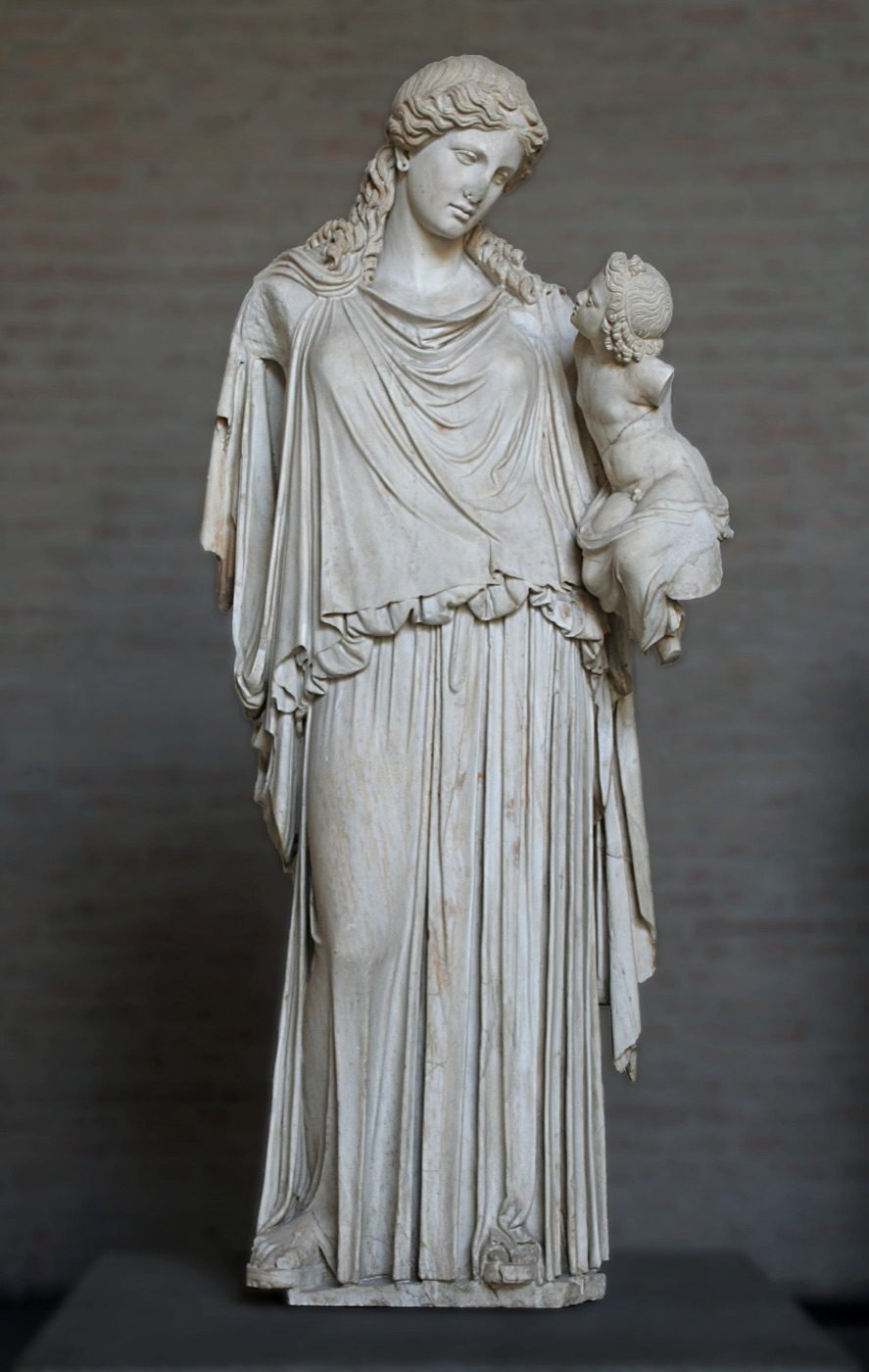
Once the cult existed, Athens commissioned a monument to match it. The sculptor Kephisodotos, working around 375-370 BC and possibly the father of the far more famous Praxiteles, cast a bronze statue for the Athenian Agora showing Eirene carrying the infant Ploutos, the personification of Wealth, a statue the 2nd-century AD travel writer Pausanias catalogued among the Agora's monuments. Describing a comparable group in Thebes later in the same work, he singles out the original for praise: "the conception of Cephisodotus, who made the image of Peace for the Athenians with Wealth in her arms" (Description of Greece 9.16.2, using the Latinized spelling of the sculptor's name). The message was not subtle. Prosperity, in the shape of a small child, only thrives when Peace is the one holding him.
Popular retellings of the statue, ancient and modern, routinely call Ploutos "her son." He is not. Hesiod's Theogony gives Ploutos a different set of parents entirely: Demeter, goddess of the harvest, and the mortal Iasion, conceived, in Hesiod's phrasing, "in a thrice-ploughed fallow in Crete." Eirene is holding someone else's child in the Kephisodotos group, and the composition reads as a statement about guardianship rather than genealogy: wealth depends on Peace the way an infant depends on whoever is actually carrying it, regardless of who gave birth to it. The original bronze is lost. What survives are Roman marble copies made centuries later, the best-preserved standing in the Glyptothek in Munich, with fragments in the Metropolitan Museum of Art and elsewhere. No ancient description or copy agrees on every detail of what Eirene originally held in her free hand, cornucopia, scepter, or torch depending on the source, the same kind of borrowed-symbol confusion that runs through Demeter's own attributes, where a similar horn of plenty traveled between several unrelated gods before popular art settled it on one.
Rome renamed her and carved her into an argument for the emperor
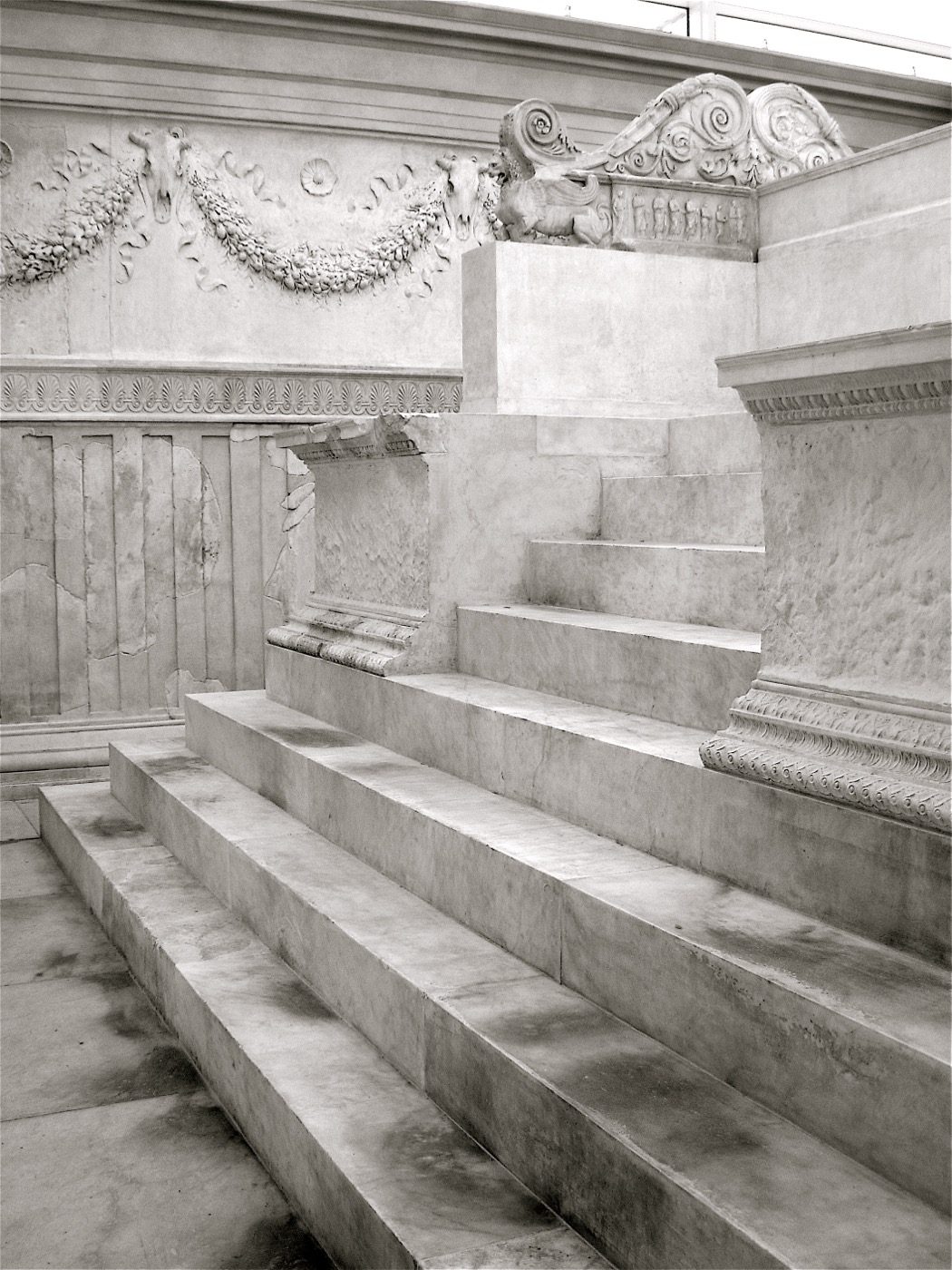
The Romans adopted Eirene as Pax, keeping the same core identity, a goddess embodying the absence of war, but her cult took on a far more openly political role under Augustus than it ever had in Athens. After Augustus returned to Rome in 13 BC from campaigns in Hispania and Gaul, the Senate commissioned an altar dedicated to Pax on July 4 of that year. The result, the Ara Pacis Augustae, was consecrated on January 30, 9 BC, and stood on the Campus Martius. Its carved reliefs pair processions of the imperial family with scenes of agricultural abundance, tying the emperor's image directly to the idea that his rule, specifically, was what made peace and prosperity possible. Where Athens built Eirene an altar after a war it won, Rome built Pax a monument to argue that one man's rule was the reason wars had stopped at all.
The altar survives today, reassembled from original fragments and matching plaster casts after a major excavation and reconstruction effort in the 1930s, and it now sits inside a purpose-built museum in Rome near its original site. It is a far more overtly propagandistic object than anything the Athenian cult of Eirene produced, but it draws on the same underlying idea Kephisodotos had already carved a few centuries earlier: peace as something that has to be actively held onto and credited to somebody, not a default state nobody bothers commemorating.