
A search that can't agree on one goddess
Type "fertility goddess" into a search engine and the results do not converge on any single figure. A fan wiki for the webcomic Lore Olympus turns up alongside Wikipedia's List of fertility deities, a stock photo library selling generic goddess imagery, and a study.com lesson page built around a quiz. Onuava, a Celtic earth goddess most readers have never heard of, sits in the mix too. That scatter is a clue about what the phrase actually is. "Fertility goddess" isn't the name of one ancient figure the way Zeus or Ra is. It is a modern descriptive category, applied after the fact to dozens of unrelated goddesses across cultures that never used the label themselves.
Where that category came from, and how well it actually fits the goddesses stuffed into it, turns out to be a stranger story than the tidy search results suggest. A similar gap between a goddess's literary debut and her actual cult shows up with Eirene, the Greek personification of peace: Athenians watched her rescued from a war god's pit on stage in 421 BC, decades before the city got around to building her an actual altar.
The classicist who proposed one goddess behind them all
The idea that a single goddess lies behind the many local fertility figures of the ancient world is not itself ancient. It was first proposed in 1849 by Eduard Gerhard, a German classicist, who speculated that the various goddesses of ancient Greek religion were all late representations of one older goddess, tied to the concept of Mother Earth, worshipped much further back into prehistory. Other classicists in France and Germany picked up the idea soon after, adding a further claim: that this Great Goddess had unified religious practice across Anatolia and Mesopotamia too, not just Greece. The theory fit neatly alongside a parallel argument from the Swiss judge J. J. Bachofen, who proposed that the earliest human societies were matriarchal before converting to patriarchy in later prehistory. As the historian Ronald Hutton has put it, once a reader already believed early society was ruled by women, a single dominant goddess behind its religion looked like the obvious conclusion.
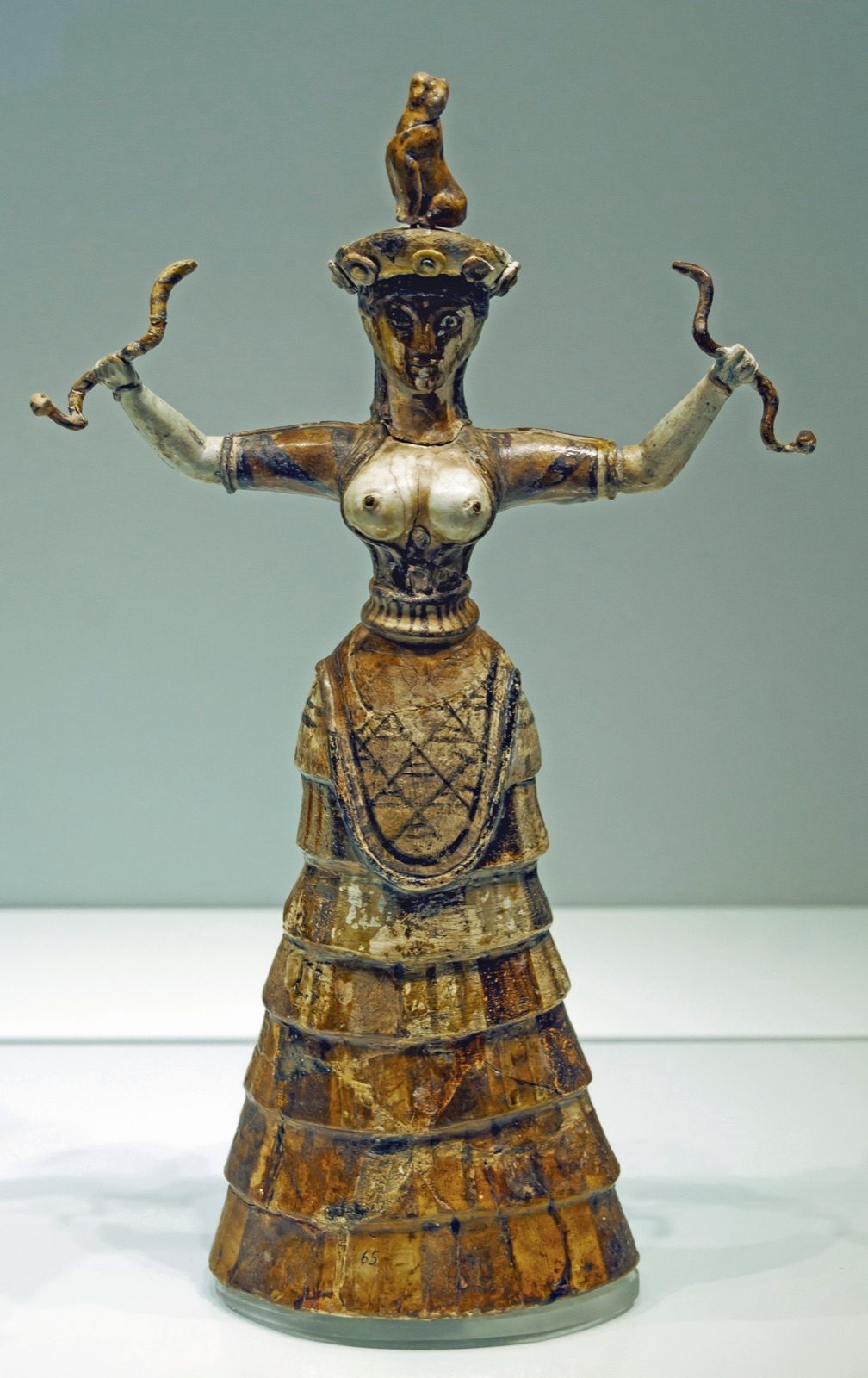
The theory got its most influential archaeological boost in 1901, when Arthur Evans began excavating the Bronze Age palace at Knossos on Crete. Evans had actually dismissed the Great Goddess idea in writing six years earlier. Digging up a set of female figurines at Knossos changed his mind: he concluded they all represented a single goddess, the chief deity of Minoan religion, paired with a subordinate male god who was both her son and her consort, an idea he based partly on the later Greek myth of Rhea and Zeus. Evans was one of the most influential archaeologists of his generation, and, as Hutton notes, his interpretation became the default position in Minoan archaeology for decades, even though some of his colleagues warned it rested on thin evidence.

Gimbutas revived the theory, and archaeology pushed back
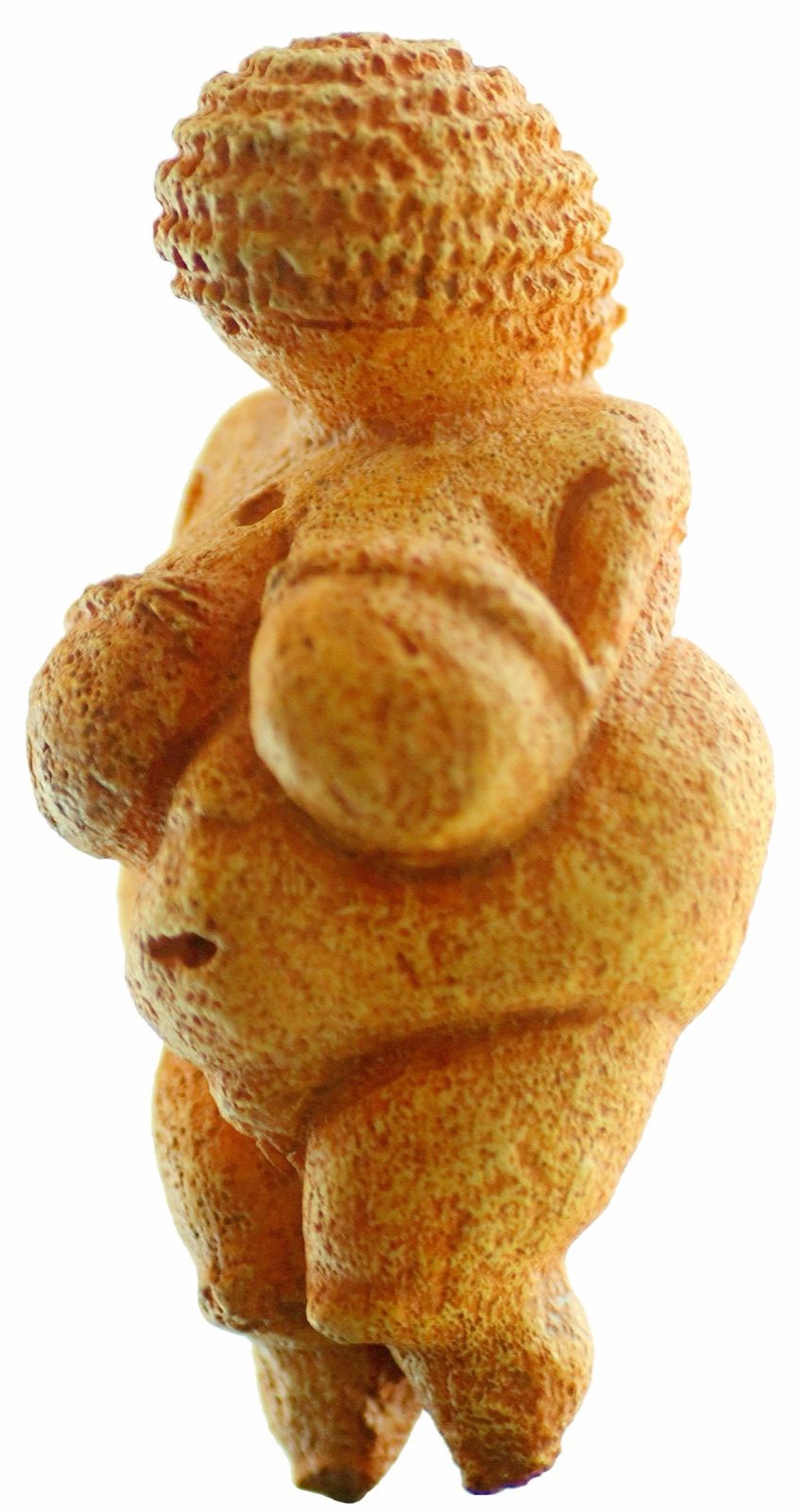
Marija Gimbutas, a Lithuanian-American archaeologist, gave the Great Goddess hypothesis its biggest 20th-century audience. Working from Neolithic figurines like the Venus of Willendorf and the terracotta goddess figures excavated at Çatalhöyük in Turkey, she argued they were expressions of a single prehistoric earth and fertility goddess, central to what she called "Old Europe," a peaceful, woman-centered society she believed existed before waves of patriarchal invaders from the steppe overran it. The same evidentiary gap shows up closer to home for this site: a Minoan terracotta figurine from Gazi, Crete, nicknamed the "Poppy Goddess" in modern scholarship, gets cited as physical backing for a fertility-goddess symbol despite archaeologists never agreeing on what the figure itself represents, and despite it predating the Greek cult it is sometimes used to support by centuries.
Mainstream archaeology did not accept Gimbutas's theory. Bernard Wailes, an anthropologist at the University of Pennsylvania, told the New York Times that most of Gimbutas's peers considered her "immensely knowledgeable but not very good in critical analysis," someone who "amasses all the data and then leaps from it to conclusions without any intervening argument." The archaeologist David Anthony directly challenged her claim of a peaceful pre-invasion society, pointing out that Neolithic Europe already had hillforts, weapons, and, by every indication, warfare, long before the Kurgan-culture invaders she blamed for ending it. An earlier critic, Peter Ucko, had already shown in a 1968 study of predynastic Egyptian figurines exactly how easy this kind of inference is to get wrong: figurines of women holding their own breasts had long been read as "obviously" about maternity and fertility, until Egypt's own Pyramid Texts revealed that gesture actually signified grief, not motherhood. By the historian Ronald Hutton's 2022 assessment, scholarly support for the Great Goddess hypothesis had waned substantially over the preceding decades.
Freyja: filed under fertility, in charge of half the war dead
Take one goddess regularly slotted into the fertility category and check what her own mythology actually has her doing. Freyja, of the Old Norse Vanir family of gods, is described in her earliest surviving sources as a goddess of love, beauty, fertility, war, gold, and seiðr, a form of prophetic magic, all at once. Fertility is one item in that list, not the whole job description. Modern rune-meaning sites lean on that same Freyja connection to explain the Fehu rune, though the three medieval poems that actually name Fehu describe something narrower than the fortune-telling tradition popularly claimed for it today.
The war side of her portfolio is not incidental. Freyja rules her own heavenly field, Fólkvangr, where she personally receives half of everyone who dies in battle; the other half go to Odin's hall, Valhalla. According to the Ynglinga Saga, part of Snorri Sturluson's Heimskringla, it was Freyja who first introduced the practice of seiðr to the ruling Aesir gods, a magical tradition until then practiced only by her own Vanir family; later medieval-period retellings go further and have her personally teaching it to Odin. She also owns Brísingamen, one of the most sought-after objects in the entire mythology, a gold necklace that jötnar repeatedly try to steal or extort from her. A goddess who commands half the field of the slain and personally imports a new form of magic into the pantheon's ruling family is not obviously best introduced to modern readers as, primarily, "the fertility goddess." Norse mythology splits divine responsibilities into specialized figures often enough elsewhere too: rather than one god of water, separate beings handle separate bodies of it, with the sea alone divided across three distinct figures.
Inanna: the goddess whose famous "fertility myth" wasn't originally about fertility
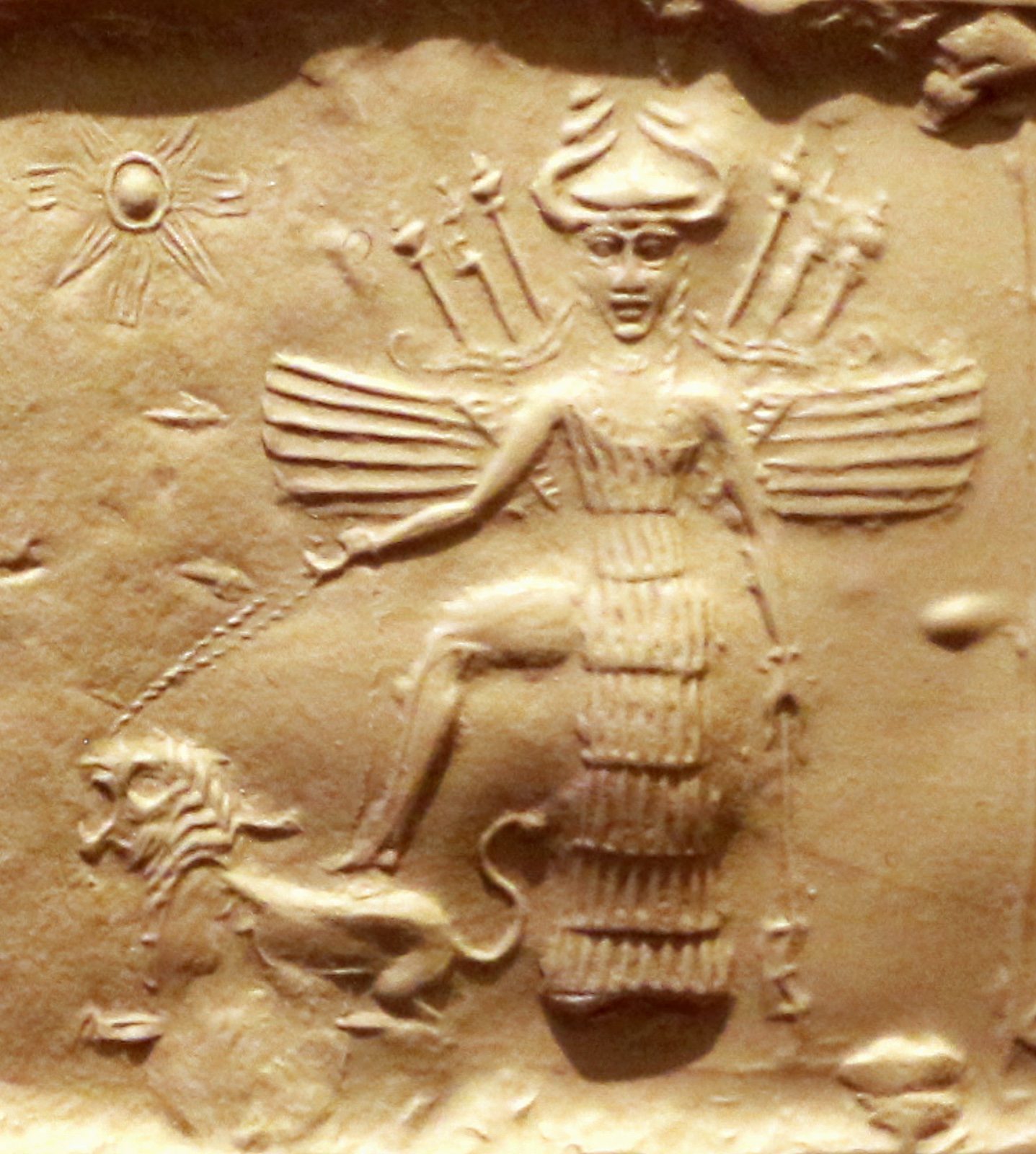
The Mesopotamian goddess Inanna, known to the Akkadians, Babylonians, and Assyrians as Ishtar, gets the same treatment. Modern reference works describe her first and foremost as the goddess of war, love, and sex, with political power, divine law, and procreation listed alongside, not fertility as her headline trait. The earliest surviving hymns to her back that up. Around 2300 BC, Enheduanna, high priestess of the moon god Nanna at Ur and daughter of Sargon of Akkad, composed hymns including the Exaltation of Inanna; she is celebrated today as the earliest named author in world history, though Assyriologists still debate how much of the surviving text, copied by scribes six centuries later, reflects her own original composition. What that poetry emphasizes about Inanna is not her fertility. It is her political and military reach: she is described seizing the kingship of heaven, holding heaven and earth in her hand, and finalizing the verdicts of the other gods.
Even Inanna's most famous story, her descent into the underworld, gets read today as a seasonal fertility myth in the mold of Persephone's disappearance, and popular retellings regularly present it that way. According to the Assyriologist Dina Katz's 2015 study of the myth's textual history, that framing was not in the original. The Sumerian version of the Descent, composed during the Ur III period around 2047-1940 BC, has nothing to do with fertility at all; references to the natural world turning barren while the goddess is dead only appear in the Akkadian-language retelling, the surviving copies of which come from the library of the Assyrian king Ashurbanipal and the city of Ashur, centuries after the Sumerian original, and Katz ties the addition to Assyrian mourning rituals built around the god Tammuz practiced in those same cities. The fertility reading modern audiences take for granted was a later liturgical addition, not the point of the story as first told.