
Four books, and only three confirmed until 2018
On July 12, 1562, in the town of Maní in the Yucatán, the Franciscan friar Diego de Landa staged an auto-da-fé aimed at Maya converts he believed were secretly continuing to worship the old gods. By his own account, the ceremony destroyed 27 Maya hieroglyphic books along with roughly 5,000 objects he classified as idols. Landa's Inquisition also involved physical torture of Maya nobles and commoners under interrogation, which he denied had caused any deaths when he was later tried over his conduct.
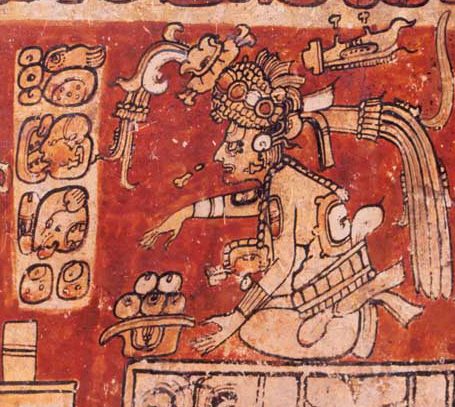
For roughly 450 years afterward, only three pre-Columbian Maya codices were confirmed to have survived that bonfire and the ones like it: the Dresden, Madrid, and Paris codices, named for the cities where they eventually surfaced in European collections. A fourth had circulated since the 1970s only as a disputed fragment nicknamed the Grolier Codex, its authenticity argued over for decades, until Mexico's National Institute of Anthropology and History ran a battery of scientific tests in 2017 and issued an official authentication in 2018, renaming it the Maya Codex of Mexico and dating its manufacture to sometime between 1021 and 1154 CE, making it the oldest surviving book in the Americas. Mesoamerican mythology keeps losing its primary sources this way in different forms: the version of Aztec mythology that survives today was reshaped after a Mexica ruler ordered painted histories burned in the 1400s, decades before any Spaniard set foot in the region.
The bitter irony is that Landa himself produced the document that later made reading the surviving fragments possible at all. His account of Yucatán, written around 1566 after he returned to Spain, included his attempt at a Maya "alphabet", a flawed but real correspondence between Spanish letters and Maya glyph sounds. Dismissed as nonsense by mid-20th-century Mayanists, it became a key starting point once Soviet epigrapher Yuri Knorozov used it in the 1950s to help crack the phonetic structure of Maya writing, the same writing system that his bonfire at Maní had made so hard to recover.
A scholar who couldn't read what he was cataloguing
In 1904, German scholar Paul Schellhas set out to catalogue the deity figures painted throughout the three confirmed codices. He had a problem: Maya hieroglyphic writing was still undeciphered, and would remain largely unreadable for another half-century, so Schellhas had no way to read the name glyphs accompanying each god. He worked from what he could see instead, cataloguing headdresses, body markings, held objects, and animal associations, and every time he identified a figure recurring across scenes with consistent visual traits, he assigned it a letter of the alphabet rather than a name. The system ran from God A through God P, with a handful of goddesses labeled separately as Goddess I and Goddess O.
Later scholars, principally Günter Zimmermann and Karl Taube, refined and extended Schellhas's original catalogue into what specialists now call the Schellhas-Zimmermann-Taube classification. It remains the standard reference system Mayanists use today for codex deities whose Classic-period names are wholly or partly unconfirmed. It isn't a historical curiosity retired once decipherment caught up; it's a working tool still cited in current scholarship. Norse mythology survives through a comparable act of outside reconstruction: nearly everything known about Odin and Thor comes from a 13th-century Christian writer's retelling, set down two centuries after Iceland's conversion, rather than a native pre-Christian record.
Matching the letters to names
As decipherment progressed through the 20th century, researchers began cross-referencing Schellhas's lettered figures against names recorded in colonial-era sources, including Landa's own writings and the 16th-century Diccionario de Motul. Some matches are now well established. God A, a death figure, corresponds to Cizin (also spelled Kisin). God B is Chac, the rain, thunder, and lightning god who strikes storm clouds with a lightning axe. God F is Buluc Chabtan, associated with war, violence, sacrifice, and gambling. God K is Bolon Tzʼakab. God M is Ek Chuaj, a merchant deity.
God D is Itzamná, generally treated as the paramount creator god of the Classic and Postclassic Maya pantheon, and even his name carries unresolved debate. Mayanist J. Eric S. Thompson originally read it as "lizard house," a translation scholars have since largely abandoned without settling on a confirmed replacement reading. Goddess O corresponds to Ixchel; Goddess I is a younger figure who appears in Dresden Codex scenes holding a maize sign, paired with a much older god whose own name has never been confidently matched to any letter at all.

The letter nobody has matched
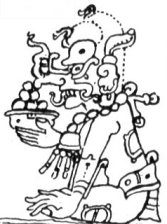
That older god paired with Goddess I is God L, and he is one of the best-documented figures in the entire codex system, which makes his missing name more striking rather than less. He recurs throughout the Dresden Codex and in monumental art, most famously on a doorjamb inside Palenque's Temple of the Cross, portrayed as visibly aged, with jaguar-marked ears, a broad feathered hat topped by an owl, and a jaguar-pattern cloak. His attributes point to at least three overlapping roles: wealth and trade, shown through a merchandise bundle and walking stick and a documented link to Gulf Coast cacao orchards; magic and shamanism, suggested by the cigar he is repeatedly shown smoking; and war, reflected in his Postclassic role as a personification of Venus rising from the underworld to spear enemies, and in a Palenque relief where he appears in a submissive posture as a defeated war chief.
None of that visual and functional detail has produced a confirmed name. God L's glyph shows the head of an aged man painted black, and its phonetic reading remains unknown. The best candidate ties him to Ek Chuah, a Yucatec merchant god that Landa himself recorded, but that name is more commonly assigned to a different codex figure, God M, so even the leading guess for God L stays contested among specialists. More than a century after Schellhas started assigning letters, one of the pantheon's most visually distinctive, functionally well-documented deities is still, formally, just "God L."
One god, or four, depending which direction you're facing
Chac's identity raises a separate complication that has nothing to do with missing names. Maya sources describe him as both one god and manifold: alongside the single figure cataloged as God B, four distinct Chaacs are tied to the four cardinal directions and their associated colors, red for the eastern sunrise, white for the northern zenith, black for the western sunset, and yellow for the south, with a fifth, green, marking the center point. Contemporary Yucatec Maya farmers carry this further still, distinguishing many more localized rain deities tied to specific clouds and rainfall patterns. The same directional splitting appears with the Bacab, an earth-and-thunder god who holds up the sky and is likewise described as four separate deities positioned at the four corners of the world.
Norse goddesses run into an inverse version of this same instability. Some scholars argue the goddesses Frigg and Freyja, treated as two clearly distinct figures in every modern retelling, actually split apart from a single earlier goddess, the mirror image of one Maya god presenting as four regional aspects. In both traditions, the tidy one-name, one-identity structure that a modern list imposes turns out to be an oversimplification the original sources never insisted on.
The "supreme god" missionaries invented
General references and tour guides sometimes describe Hunab Ku as the Maya's single, formless supreme creator god, standing above the entire pantheon much like a monotheistic deity. The earliest documented appearance of the term supports a very different origin. It shows up in the 16th-century Diccionario de Motul, described there as "the only living and true god" who "had no form because they said that he could not be represented as he was incorporeal." That dictionary, though, was compiled by Franciscan missionaries working to translate the Christian God into Yucatec Maya for the purpose of religious conversion, not to record a pre-existing native belief. Linguist William Hanks's research situates the term inside that missionary vocabulary specifically, and it appears in no pre-conquest Maya inscription. It does turn up later in the Book of Chilam Balam of Chumayel, a syncretistic text written after the conquest, where colonial writers linked Hunab Ku to the genuinely indigenous creator god Itzamná to smooth the path of conversion.
The idea that Hunab Ku was an authentic ancient high god got a major boost from an unlikely source: archaeologist Sylvanus Morley's respected 1946 book The Ancient Maya asserted it as fact, likely carrying the missionary-era translation into 20th-century popular and semi-scholarly accounts as though it had always described pre-conquest theology. In the 1950s and 1960s, Mexican author Domingo Martínez Parédez went further, reinterpreting Hunab Ku as proof of pre-Hispanic Maya monotheism and linking it to Freemasonry concepts, including the Great Architect of the Universe. The final layer arrived in the 1980s, when José Argüelles's 1987 book The Mayan Factor popularized a circular black-and-white spiral design as an ancient "Hunab Ku glyph" representing galactic consciousness. That symbol appears in no pre-Columbian Maya artifact; researchers have traced its likely visual source to an Aztec motif representing Ollin, or movement, a different culture's design pressed into service as Maya scripture centuries after the fact.
A letter standing in for a missing name and an invented name standing in for a whole invented god are opposite mistakes, but they come from the same underlying gap. What most people encounter as "the Maya gods" is a modern reconstruction project built from a handful of surviving books, colonial-era Spanish paperwork, and later scholarly guesswork, and it is still being revised today, as recently as the fourth codex's 2018 authentication, rather than a finished list handed down whole from the Classic period. Spanish rule reshaped the Andean record as well; among the Inca deities, the sun god's festival was rebuilt in 1944.