
The pillar predates the god it is now said to belong to
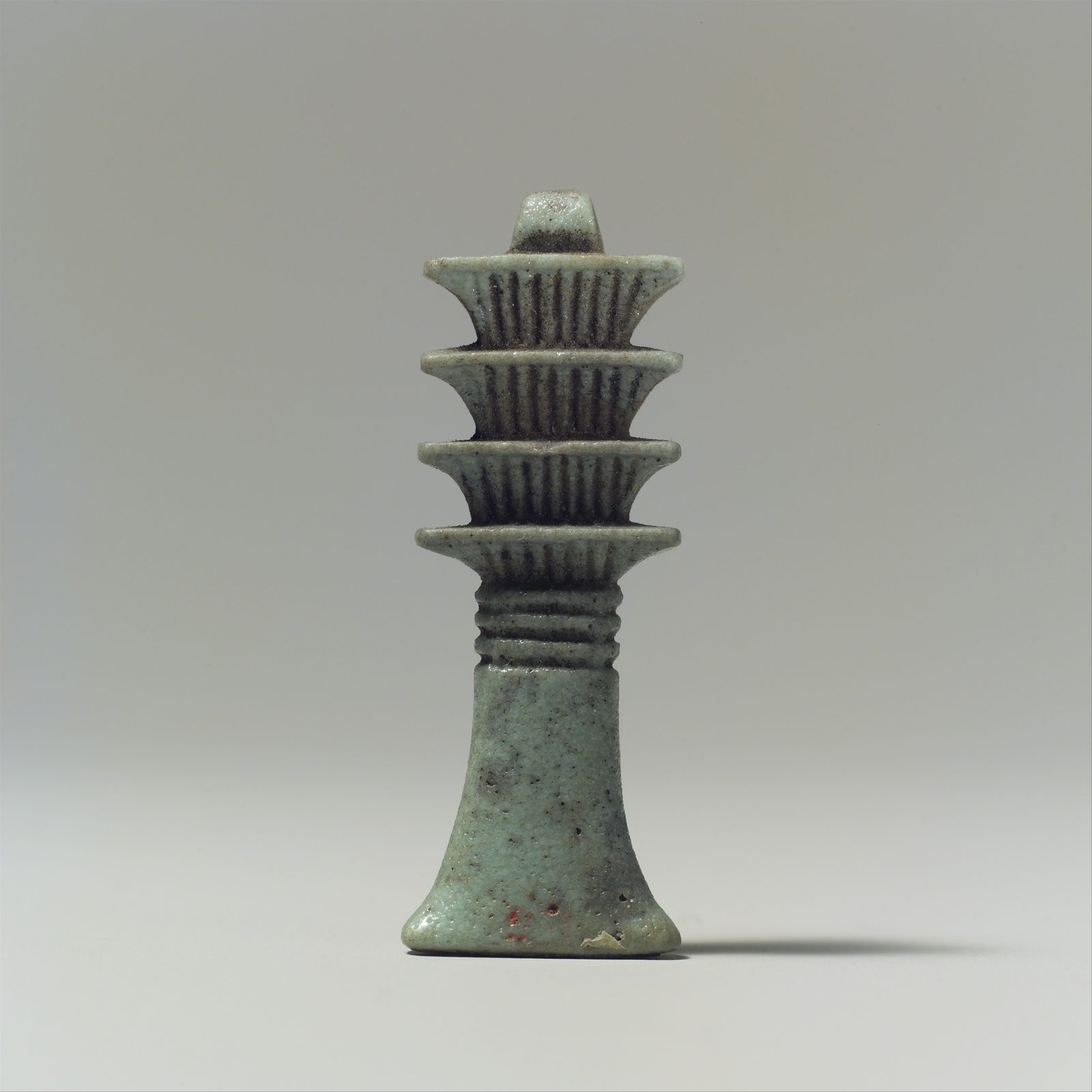
The djed is one of the oldest and most common symbols in Egyptian religious art: a pillar-like hieroglyph, read as a sign of stability, that modern explainers almost always gloss as "the backbone of Osiris." That reading is real, but it is not original. According to Wikipedia's entry on the djed, the symbol may have started as a fertility-cult pillar built from reeds or sheaves, or a totem pole grain was piled around or hung from, and it was tied first to Seker, the falcon god of the Memphite Necropolis, then to Ptah, the Memphite patron god of craftsmen, who was referred to as "the noble djed" and carried a scepter combining the djed with the ankh. The World History Encyclopedia's account is more direct about the timeline: the djed began as a fetish of the Memphite gods Ptah and Sokar, and "only later, as the Osiris cult rose to dominate Egyptian ideas of death and rebirth, was the old pillar absorbed into his story and reinterpreted as his backbone." By the New Kingdom the Osiris association was firmly in place, but the symbol had already been doing other religious work for a long time before that.
One further theory pushes the pillar's origin even further from anatomy. In their 2004 book The Quick and the Dead: Biomedical Theory in Ancient Egypt, Andrew Hunt Gordon and Calvin W. Schwabe proposed that the djed, along with the ankh and the was-sceptre, has a basis in cattle butchery: the djed's shape, on this reading, comes from the sacrum of a bull's spine rather than a human one, tied to an Egyptian belief that semen originated in the spinal column. Whether or not that specific anatomical claim holds, it points to the same pattern the mainstream Egyptological account already describes: the "backbone" reading is a layer added on top of an older symbol, not the symbol's starting point.

Isis, a tree at Byblos, and the myth that explains the pillar
The Osiris myth supplies its own explanation for the backbone reading, and it doubles as the origin story for the object itself. In Egypt's wider pantheon, Set tricks Osiris into a coffin built to his exact measurements, seals it, and throws it into the Nile. The coffin drifts to the coast near Byblos, in modern Lebanon, where a tree takes root around it and grows rapidly enough that the local king has it cut down and installed as a pillar in his palace, unaware his new pillar has a god's body inside it. Isis tracks Osiris to Byblos, talks her way into the royal household, and is granted the pillar as a boon; she extracts the coffin, then consecrates the emptied pillar with myrrh and linen, and that consecrated pillar becomes the djed. In Egyptian art the djed is frequently paired with the tyet, or Isis knot, a hieroglyph read as "life" or "welfare," and the two together are usually taken as a visual shorthand for the pairing of stability and life the myth itself describes. It is a myth built to explain an existing cult object, though, in the same way origin stories often get attached to symbols that already existed, and it does not overturn the separate archaeological and textual record showing the djed was doing religious work under Ptah and Seker well before an Osiris cult substantial enough to need this story existed.
The pillar was raised upright in a real ceremony at Abydos
The djed's stability symbolism was acted out, not confined to amulets and hieroglyphs. "Raising the djed" was a real ceremony, performed during Khoiak, the fourth month of the Season of the Inundation, when the year's agricultural cycle was beginning. According to Wikipedia's account, the pharaoh, assisted by priests, used ropes to haul a large wooden djed column from lying flat to standing fully upright, and the act was explained as Osiris's triumph over Set. Abydos, the major cult center for Osiris, hosted an elaborate version of the festival, and a surviving relief on the west wall of the Osiris Hall there depicts the raising in progress. The pillar going from horizontal to vertical stood for the god rising from death, for order overtaking chaos, and for the pharaoh's own rule being renewed for another cycle alongside the harvest.
Egyptologists have reconstructed the ceremony's choreography from temple reliefs and ritual papyri rather than inferring it purely from what the symbol is supposed to mean, which puts it on firmer footing than most "ancient symbol" explainers, where a claimed ritual use often gets asserted with little textual backing behind it. Here the sequence of actions, the season, and the location are all independently attested.
The crook stood for rule for millennia before it belonged to any single king
The crook and flail (heka and nekhakha), much like Anubis's own signature emblems, are usually introduced as a matched set: the shepherd's crook for kingship, the flail for the fertility of the land, both originally Osiris's own attributes that pharaohs adopted as insignia. The crook side of that story holds up well. The earliest known example comes from tomb U547 at Abydos, from the Gerzeh culture of the Naqada II period, well before Egypt's unification, and the crook was already an established symbol of rule by the late Predynastic period. The flail started out depicted separately in early royal ceremony and only became formally paired with the crook by around the Second Dynasty. The only complete pharaonic examples of both objects together come from the tomb of Tutankhamun, where the staffs are heavy bronze wrapped in alternating stripes of blue glass, obsidian, and gold, and the flail's beads are gilded wood.
Crossed over the chest, as they are shown in almost every royal and Osirian image, the pair is traditionally read as the ruler acting as a shepherd, generous but capable of coercion. Toby Wilkinson reads the flail specifically as a goad for livestock, a symbol of the coercive power behind the ruler's benevolence, while E.A. Wallis Budge argued it represented a tool for threshing grain.
The flail may never have been a flail
Egyptologist Percy Newberry broke with both of those readings. In a 1929 paper in the Journal of Egyptian Archaeology titled "The Shepherd's Crook and the So-Called 'Flail' or 'Scourge' of Osiris," he argued the object was mechanically incapable of functioning as either a whip or a flail, based on close study of surviving examples and their proportions.
He proposed instead that it was a ladanisterion, a tool for gathering fragrant labdanum resin from cistus shrubs, and drew the comparison to instruments used by nineteenth-century Cretan shepherds, who used a similar rake-like tool to comb resin off the shrubs their flocks grazed among. That ties the object back to actual pastoral life rather than to a purely symbolic whip. Newberry took the idea further still, asking in the same paper whether Osiris's false beard, worn hooked below the chin in nearly every image of him, might originally have represented a resin-laden goat's beard rather than a mark of divine authority on its own.
None of this displaces the crook and flail's role as royal insignia by the time of the historical pharaohs; that use is not in dispute. What it complicates is the assumption that the objects were designed from the start as symbols of shepherding and threshing. On Newberry's reading, the "shepherd" association may be a secondary reinterpretation of an actual shepherd's tool, just repurposed for gathering resin rather than herding animals, which would make the crook and flail's meaning almost the reverse of the standard explanation: not symbolic tools borrowed from real shepherding, but a real tool that picked up symbolic weight. Symbols and relationships built on a single inherited assumption turn out to be common across old literature generally; whether Achilles and Patroclus were lovers has been argued the same way for twenty-five centuries, with no ancient text ever actually settling the question.
A white crown, feathered: the Atef
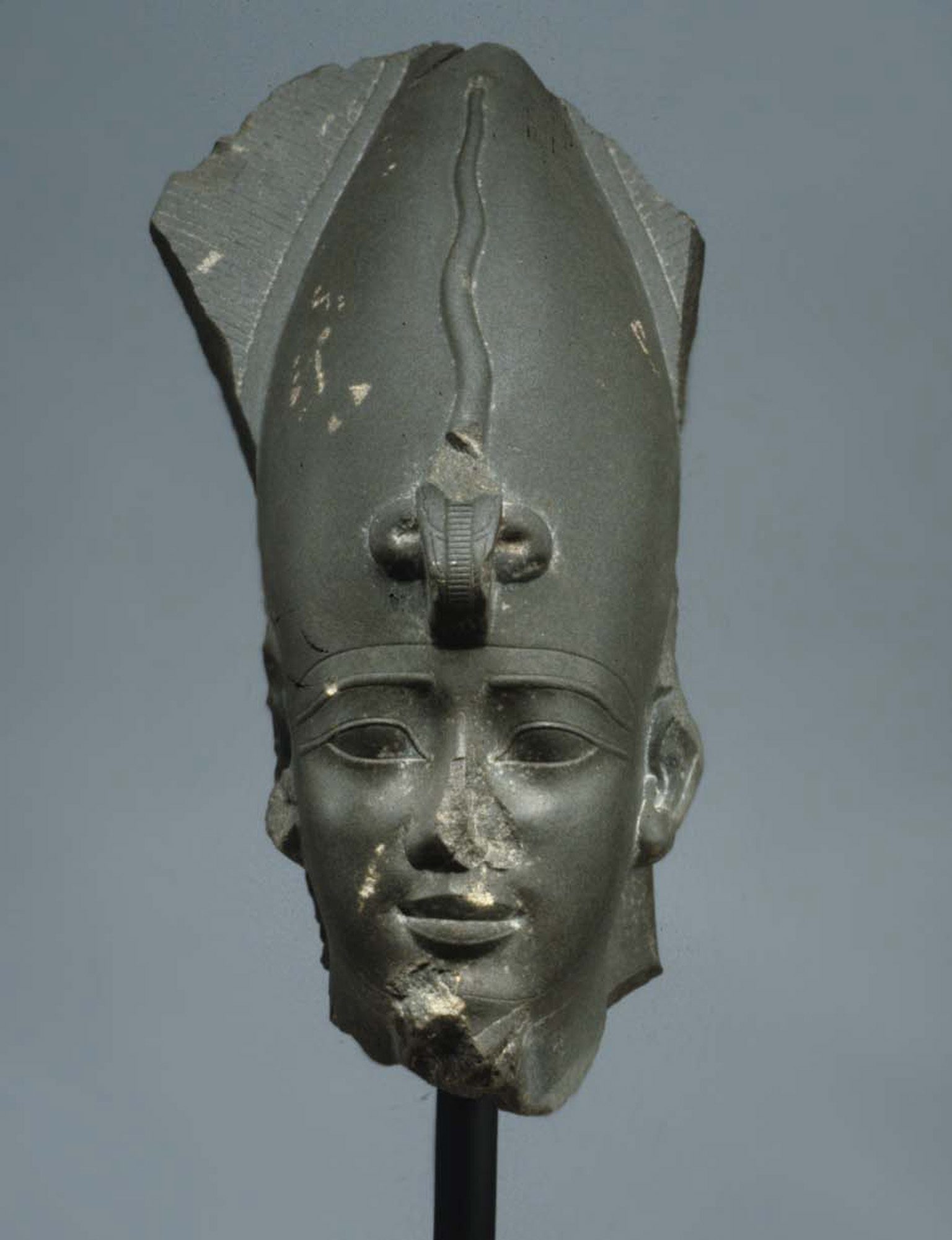
Compared to the djed and the flail, the Atef crown has the least contested backstory. It combines the Hedjet, the plain white crown of Upper Egypt first recorded in the Predynastic period, with a pair of curled ostrich feathers, one on each side, identifiable as ostrich specifically by the curve at their upper ends. The feathers stand for truth and justice, the same single feather worn by Ma'at, the concept of order woven through the Eye of Horus's own symbolism, and they are distinguishable from the two-feather crowns worn by gods like Amun, whose feathers are narrower, straighter, and lack the curve. The crown marks Osiris in Egyptian painting as unmistakably as any attribute in the pantheon does; there is no competing origin story or reinterpretation layered underneath it the way there is with the pillar or the flail.
The Atef also has an afterlife of its own inside Egyptian iconography: the Hemhem crown, a taller, triple-plumed royal and funerary crown, is essentially a doubled or tripled version of the Atef, sometimes described directly as a "triple Atef." That later crown shows up combined with ram's horns and sun-disks in some New Kingdom funerary contexts, one more example of how a symbol built for one god kept getting recombined and reused well past its original context, the same pattern that runs through the djed and the crook and flail, just without the disputed origin story attached. Egyptian symbols taking on a tamer, more general meaning than the myth underneath them actually supports isn't limited to royal regalia either: the Eye of Ra gets sold today as a general protection symbol, even though the fuller version of that myth has the eye going rogue and nearly wiping out humanity.