
A tribute that came due every nine years, not every year
Plutarch traces the tribute back to a war. After Minos's son Androgeus died in Attica, reportedly through treachery, Minos attacked the region and Athens was struck at the same time by crop failure and plague. An oracle told the Athenians that making peace with Minos would end their suffering, so they sent envoys and agreed to his terms. Plutarch records the deal directly: "they sent an embassy to Minos and prevailed on him to make peace, on the condition that every nine years they should send him a tribute of seven youths and seven maidens." Not annually. Once per nine-year cycle, seven boys and seven girls, sent to Crete and, in the version Plutarch calls "the most tragic of the legends," fed to the Minotaur inside the Labyrinth or left to starve there, unable to find the way out.
The nine-year interval also explains a detail that's easy to skip past: Theseus doesn't volunteer for the first shipment. Plutarch places his enlistment at "the third payment of the tribute," by which point fathers with grown sons had already endured two earlier rounds of the lottery and the city was starting to blame Aegeus for staying exempt from a burden everyone else carried. Theseus offers himself unasked. On one account he's chosen anyway, one of several youths selected by lot; on another, preserved by the historian Hellanikos, Minos sails to Athens in person and hand-picks Theseus first, on the condition that the Athenians supply the ship and the youths travel unarmed, tribute to cease entirely once the Minotaur is dead.
A fight breaks out before the ship even reaches Crete
Most retellings skip straight from the ship's departure to the Labyrinth. Bacchylides's Ode 17, composed for a chorus from Ceos, puts an entire confrontation in between. Sailing to Crete with the tribute, Minos lays a hand on one of the Athenian girls, Eriboea, who cries out. Theseus objects, and the two men escalate into a contest over parentage: Minos calls on his own father, Zeus, to send lightning as proof of his birth, and Zeus obliges. Minos then throws a gold ornament from his own hand into the sea and dares Theseus, if he's really the son of Poseidon, to bring it back from the depths.
Theseus dives without hesitating. Dolphins carry him down to Poseidon's hall, where he finds, in the poem's own words, "the dear wife of his father, holy, ox-eyed Amphitrite," who wraps him in a purple cloak and crowns him with a wreath of dark roses, a gift Aphrodite had given her at her own wedding to Poseidon. He surfaces beside the ship unwetted, jewelry intact, and the Athenian youths who'd been weeping at his disappearance break into a paean instead. It's a full episode with its own reversal and its own reward, and it happens before Crete is even in sight, let alone the Labyrinth.
One ancient historian didn't believe there was a monster
Plutarch doesn't just report the popular story and move on. He devotes an entire chapter to writers who rejected it outright. "Philochorus says that the Cretans do not recognise this story," he writes, "but say that the Labyrinth was merely a prison, like any other, from which escape was impossible." In this version, Minos held funeral games for Androgeus, and the imprisoned Athenian children were simply the prize awarded to the winner. That winner, in the first contest, was "a man of great power in the state, a general of the name of Taurus," bull in Greek, whose harsh treatment of the Athenian youths, not any monstrous anatomy, was the actual danger. Theseus's task, on this telling, was to beat Taurus in the games, which he did, after which Minos, delighted at seeing an unpopular general humiliated, released the children and cancelled the tribute for good. Nobody dies inside a maze.
Other writers Plutarch cites push the rationalizing even further apart from each other. Demon has Taurus killed not in a wrestling match but in a naval battle in the harbor as Theseus's ship makes its escape. Aristotle, in a treatise on the constitution of the Bottiaeans that Plutarch cites directly, denies the children died in Crete at all, arguing they lived out ordinary lives there as slaves into old age, and that their descendants eventually left for Italy and then Thrace, founding the people later known as the Bottiaeans, who, Plutarch notes, still sang "Let us go to Athens" during a certain sacrifice in his own day. Three writers, three separate fates for the missing children, none of them a bull-headed monster in a maze.
The written record says fists. The pottery mostly says a sword
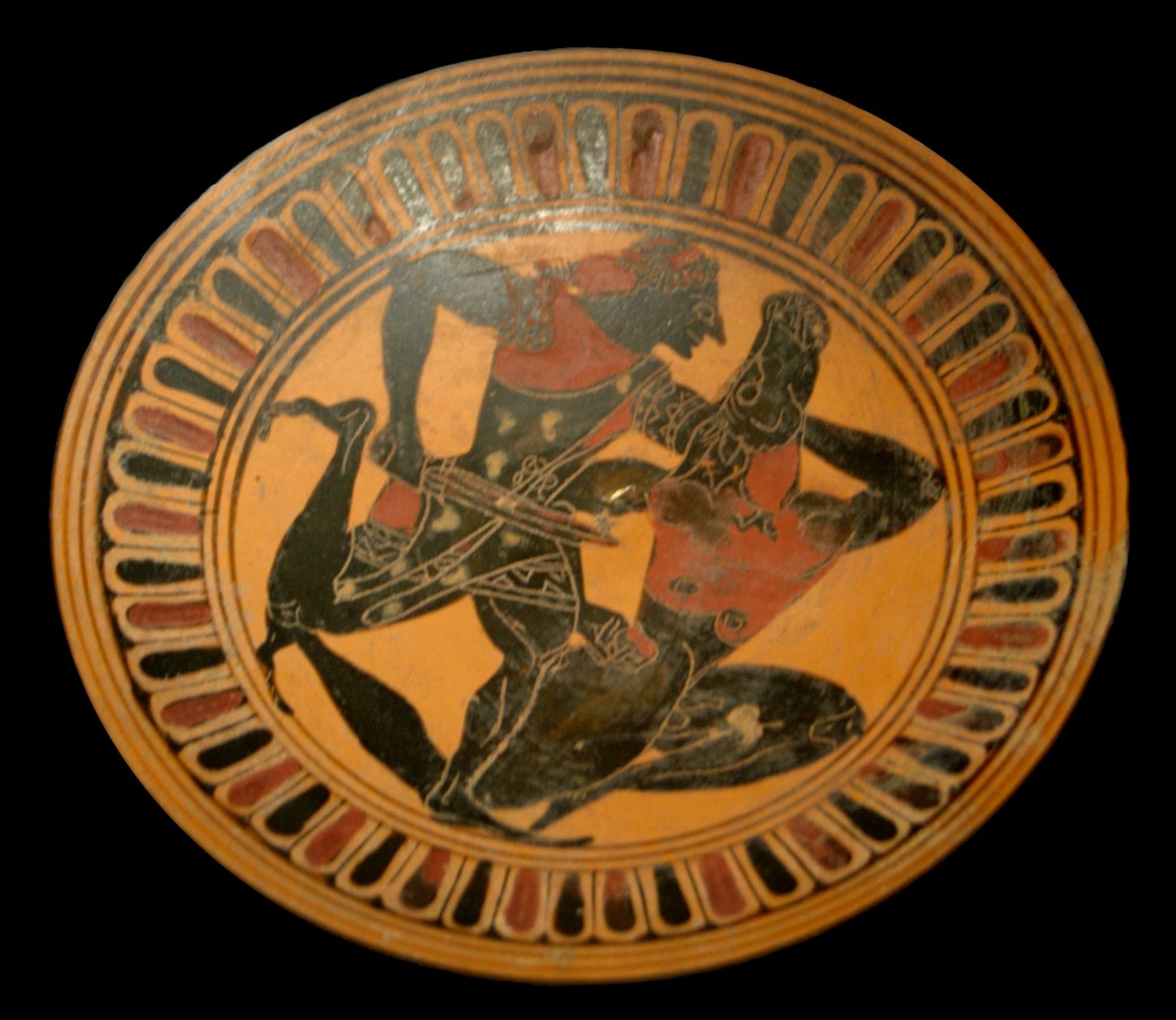
Where sources do keep the monster, they can't agree on how it died. The Epitome of Apollodorus's Library gives the fight one line: Theseus, following Ariadne's thread back out of the Labyrinth, "having found the Minotaur in the last part of the labyrinth, he killed him by smiting him with his fists." No weapon. Attic vase painters overwhelmingly disagreed with that detail, favoring a sword driven into the Minotaur's neck or chest as the scene's centerpiece across dozens of surviving black-figure and red-figure pieces from the 6th and 5th centuries BC. A rarer strand of the pottery tradition sides with Apollodorus instead. A black-figure kylix now in the Louvre, catalogued as F83 and dated to around 450 to 440 BC, shows Theseus with no weapon at all, gripping the collapsed Minotaur by the horn in what reads as a wrestling hold rather than a killing blow, closer to Apollodorus's fists than to the sword-wielding Theseus that shows up on most other painted vessels.
Ariadne's ending splits at least four ways
Plutarch spends more space cataloguing Ariadne's fate than he does the Minotaur's death, and admits upfront that the accounts "do not agree in any particulars." One version has her hang herself after Theseus abandons her. Another, which Plutarch treats as the most common, has her left on Naxos and taken in by Oenarus, a priest of Dionysus, while Theseus sails home already in love with someone else, a woman named Aegle. A third, attributed to a writer named Paeon of Amathus, is far more specific and far stranger: a storm forces Theseus's ship to Cyprus, Ariadne, pregnant and seasick, is put ashore while Theseus returns to secure the ship and gets blown back out to sea; the local women nurse her, forge letters as if from Theseus to comfort her, and bury her after she dies in childbirth, at which point a grieving Theseus endows a sacrifice in her honor and sets up two statues, one silver and one bronze.
A fourth tradition, which Plutarch attributes to writers from Naxos itself, resolves the contradictions by inventing a second Ariadne. In this version there were two Minoses and two Ariadnes: an elder Ariadne married Dionysus on Naxos and became the mother of Staphylus and Oenopion, while a younger Ariadne, a different woman entirely, is the one Theseus carries off and later abandons. Naxian cult practice, per Plutarch, kept the two figures separate even in worship, with "merriment and revelry" at the elder Ariadne's festival and "gloomy rites" mingled with the celebration at the younger one's. Four incompatible endings, recorded by one biographer, for one woman.
The sail's color wasn't settled either, and neither was who forgot
The version everyone knows ends with a signal system: black sail for failure, white for success, and Aegeus, watching from the cliffs, throws himself into the sea when the ship returns under black canvas, dying under the mistaken belief his son is dead. Plutarch records that system, but immediately complicates it. "Simonides says that it was not a white sail which was given by Aegeus," he writes, "but 'a scarlet sail embrued in holm oak's juice,' and that this was agreed on by him as the signal of safety." White in most tellings, crimson-red according to a poet writing centuries closer to the events than most of the other sources that survive.
Plutarch also spreads the blame differently than most modern retellings do. Rather than making the oversight solely Theseus's fault, he writes that "both he and his steersman in their delight forgot to hoist the sail which was to be a signal of their safety," putting the mistake on two men rather than one. The ship that carried it all out had a longer afterlife than the myth itself: Plutarch notes that Athenians preserved the actual vessel for centuries, replacing its rotting timbers plank by plank, until philosophers started arguing over whether a ship with none of its original wood left was still the same ship. That argument is the origin of the Ship of Theseus paradox, still debated in philosophy departments under a name that credits this exact voyage.