
The meaning cards say Freyja. The medieval poems don't say anyone.
Search "Fehu meaning" and the results converge fast: a rune associated with the goddess Freyja, tied to fertility and abundance, said to signal new financial beginnings when drawn upright. Rune-reading shops and divination blogs present this pairing as settled lore, something carried down from the Viking Age along with the symbol itself. It reads like a fact with a paper trail.
The paper trail doesn't hold up. Three genuine rune poems survive from the medieval period, the Old English poem probably composed in the 7th century and copied into a 10th-century manuscript, the Old Norwegian poem from the 12th or 13th century, and the Old Icelandic poem recorded around 1500. All three include a stanza for this rune, called Feoh in Old English and Fé in the Norse versions, and all three describe wealth. None of them names a god. That absence is worth noticing because the same poems do name gods elsewhere: the Norwegian and Icelandic stanzas for the T-rune both open by identifying it outright, "Tyr is a one-handed god," alongside the rest of the pantheon the sagas record by name. If the poets who wrote down the wealth stanza had a specific deity in mind, the convention for saying so already existed. They didn't use it.
Where the Freyja pairing actually comes from
The attribution has a documented origin, and it's about a century old. In 1902, the Austrian mystic Guido von List, recovering from cataract surgery that left him temporarily blind, said the meanings of a new set of 18 runes came to him during that blindness. He published the system in 1906 as Das Geheimnis der Runen, "The Secret of the Runes," calling his symbols the Armanen runes. Unlike the Elder Futhark, Anglo-Saxon futhorc, and Younger Futhark, whose existence rests on thousands of dated inscriptions, the Armanen row has no archaeological basis. List assigned his own reworked meanings even to symbols that share a shape with genuine runes, giving Fehu associations with fire and destruction that don't appear in any of the three medieval poems.
Later 20th-century rune-reading traditions, drawing on List's framework and on the wider revival of divination practices, settled on Freyja in place of List's own reading, tying Fehu to her established associations with gold, fertility, and prosperity. That layer is a real, decades-old tradition in its own right. It just isn't the tradition the ninth-century Elder Futhark speakers or the poets who wrote the medieval rune poems would have recognized, and presenting it as continuous with them collapses two different eras into one.
The rune itself, and how it went unreadable for over a thousand years
The Elder Futhark is the oldest runic alphabet, 24 characters used by Germanic peoples across the migration period. Fehu stands first in it, transliterated as the sound f, occasionally shifting toward v the way English "leaf" shifts to "leaves" in the plural. The rune's shape, two diagonal strokes branching up from a vertical stave, is usually traced to the Old Italic alphabets in use among Mediterranean peoples in the first century CE, most likely reaching Germanic tribes through contact with Italic-alphabet users rather than through Greek, since the timeline for Greek contact doesn't line up with when the earliest runic writing appears.
That earliest writing is older than most visitors to a rune website would guess. The Vimose comb, found in Denmark, carries the oldest securely dated runic inscription, from around 160 CE. The Kylver Stone, a limestone slab excavated from a cemetery at Kylver, Gotland, in 1903, dates to about 400 CE and gives the earliest known listing of the full 24-rune row in order, scratched onto the underside of a stone used to seal a grave. But the ability to actually read the Elder Futhark specifically didn't survive into the modern era. Scandinavia simplified the alphabet into the 16-rune Younger Futhark by the late 8th century, while the Anglo-Saxons extended it into the futhorc, and direct knowledge of the older 24-rune system was lost somewhere in that transition. It stayed lost until 1865, when the Norwegian philologist Sophus Bugge worked out how to decipher it.
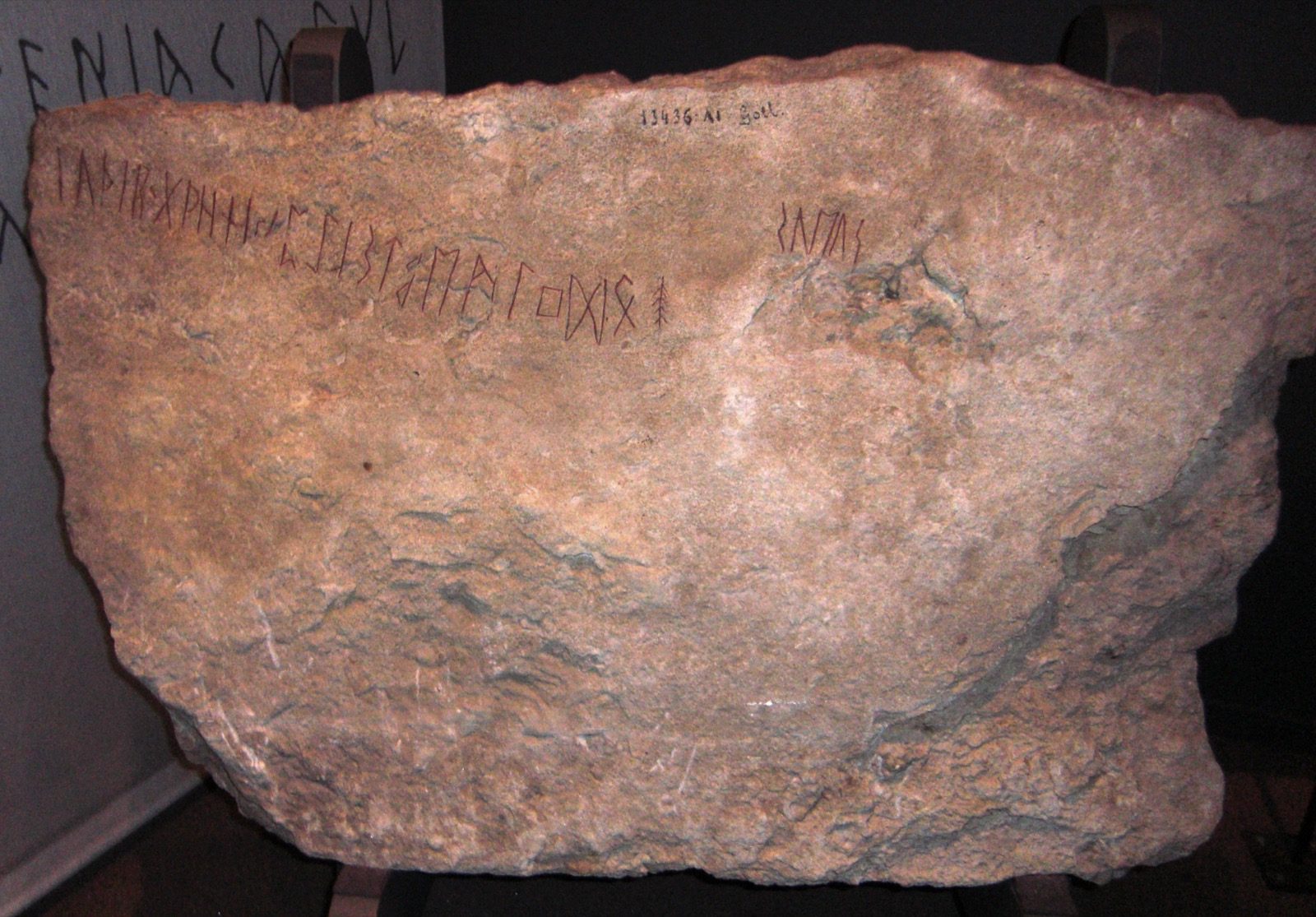
From livestock to legal tender, and a false cognate worth clearing up
The name itself is a reconstruction. No Elder Futhark inscription spells out the rune's own name; linguists rebuilt the Proto-Germanic form *fehu, "livestock, cattle," from its known descendants: Old Norse fé, Old English feoh, Old Saxon fehu, Old High German fihu, modern German Vieh, Dutch vee, Swedish fä, and Gothic faihu, the last of which already carries the extended sense "money, fortune." That the Gothic letter name matches the reconstructed Elder Futhark name so closely is part of why runologists trust the reconstruction; independent branches of the same language family converged on the same word.
Go back further and the trail connects to Sanskrit paśu and Latin pecu, both "cattle," descending from a shared Proto-Indo-European root, *peku-. Latin pecu is also the ancestor of pecunia, "money, property," the direct source of English "pecuniary." Old English feoh went on to become the modern English word "fee," by way of a separate Anglo-French word for feudal landholding that merged with it in Middle English. Livestock, in other words, gave two different European language families two different words for money, independently, because owning animals was for a long stretch of history the most legible way to own wealth at all.
One word that looks like it belongs on this list doesn't. The English word "cattle" is not a cognate of fehu, despite the tempting overlap in meaning. It comes from Anglo-French catel, ultimately from Medieval Latin capitale, "property, principal sum," itself from Latin caput, "head," the same root that gives English "capital" and "chattel." Etymonline's entry for cattle notes the resemblance to fee only as a parallel case of the same kind of sense development, livestock standing in for wealth in general, not a shared ancestor. Two unrelated word families made the identical leap from "animal" to "asset" on their own.
What the wealth stanza actually says, once you read all three
There was probably once a poem written for the Elder Futhark itself, but it hasn't survived; the three poems that do survive describe the later 16-rune Younger Futhark (Norwegian and Icelandic) and the expanded Anglo-Saxon futhorc, and their wording for this shared first rune is close enough to suggest a common older source. In Bruce Dickins's 1915 translation, still the most widely circulated public-domain edition, the Old English poem reads: "Wealth is a comfort to all men; yet must every man bestow it freely, if he wish to gain honour in the sight of the Lord." The emphasis lands on distribution. Wealth that sits unshared doesn't earn the standing wealth is supposed to buy.
The Norwegian poem strikes a harder note: "Wealth is a source of discord among kinsmen; the wolf lives in the forest." Each stanza in that poem pairs an abstract line with a concrete image, and the pairing here reads less like a riddle to solve and more like a warning: property disputes fracture families the way a wolf, an outlaw's fate in Norse law, waits outside the boundaries of settled life. The Icelandic poem compresses the same warning into three kennings: "source of discord among kinsmen, and fire of the sea, and path of the serpent." "Fire of the sea" is a standard skaldic kenning for gold, built on the old association between the sea and hidden treasure. "Path of the serpent" points the same direction from a different angle: in the best-known version of that image, the dragon Fafnir coils around a hoard of cursed gold he killed his own father to keep, so a serpent's trail is a gold hoard's trail. All three poems, in three languages and three centuries, land on the same idea: wealth is real, wealth is worth having, and wealth is also the thing most likely to turn kinsmen against each other.
Was fortune-telling with runes ever a documented practice?
The claim that runes were used for divination since antiquity usually traces back to one Roman source, and it's shakier than the confident tone of most rune-meaning sites suggests. Around 98 CE, the historian Tacitus wrote in his Germania that Germanic peoples cut marks into strips cut from a fruit tree, scattered them at random onto a white cloth, and read meaning from how they fell. Tacitus never calls the marks runes, and runologists have flagged real problems with treating the passage as proof anyway: Tacitus is describing a society he likely never visited firsthand, the marks he describes could have been any kind of symbol, not necessarily runic writing specifically, and the earliest runic inscriptions that survive, the Vimose comb among them, date to roughly half a century or more after he wrote, which weakens any direct link between his account and an established runic practice.
None of that proves runes were never used for divination in the pagan period. It means the evidence usually cited for it is thinner and more contested than it's presented as being, closer to an open question in runology than a documented tradition running unbroken from Tacitus to today's rune sets. Norse religious practice more broadly had no centralized priesthood standardizing what any given ritual meant, which makes a single, universally agreed divinatory meaning for any one rune, ancient or modern, unlikely on its own terms.