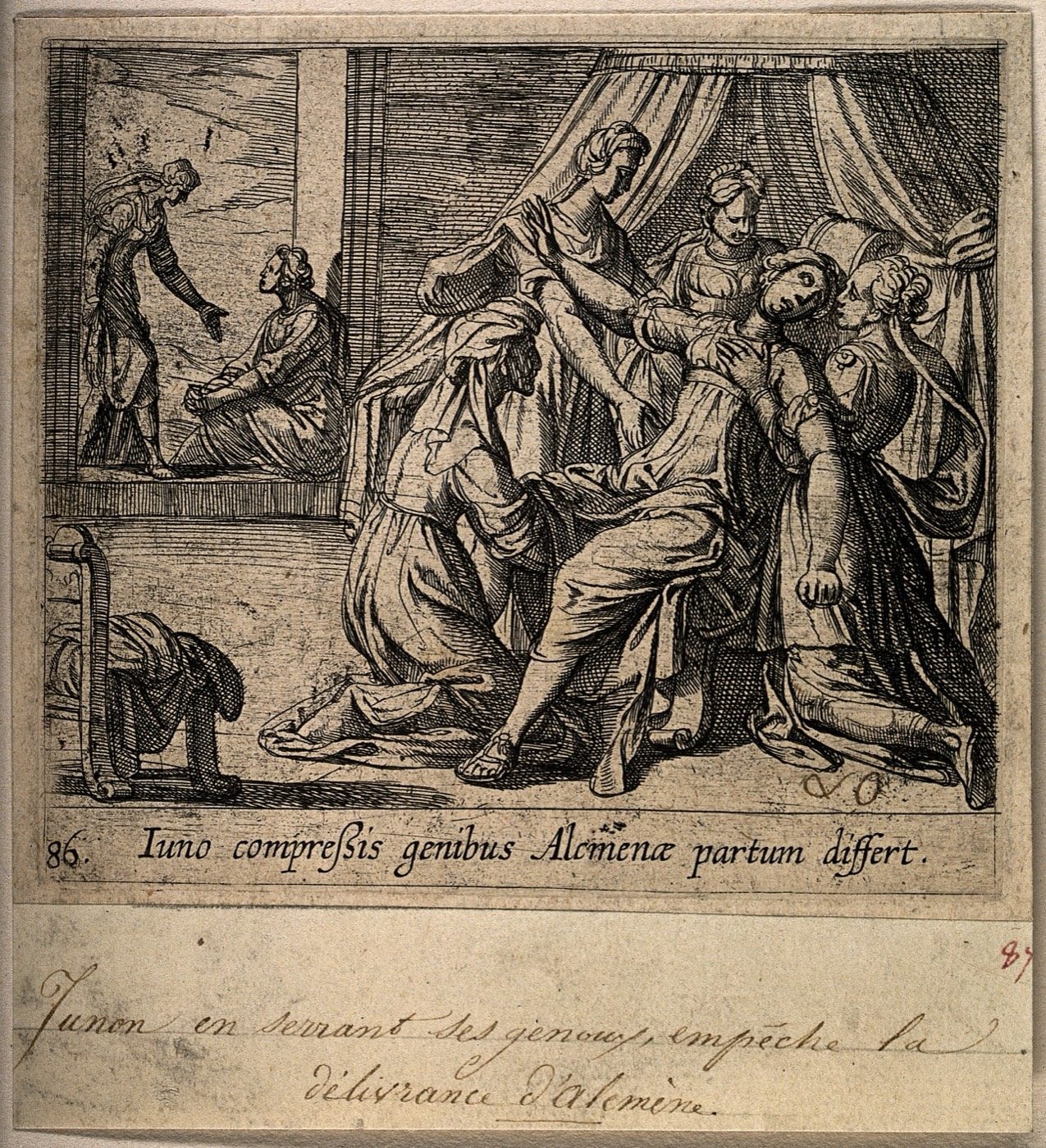

Alcmene, mother of Heracles by Zeus and of a second son by her own husband
Hercules's mother was Alcmene, a mortal queen and granddaughter of the hero Perseus. She was married to a Theban exile named Amphitryon, and ancient sources describe her bearing twin sons on a single night: Heracles, fathered by Zeus, and Iphicles, fathered by Amphitryon himself. Most retellings stop there, treating her as background to someone else's story, but the ancient record gives her a contested family tree of her own, a war her husband had to win before she'd marry him, and, decades later, a death that two rival Greek cities described in two incompatible ways.
Everything past that opening fact, the deception that conceived Heracles, Hera's attempts to stop the birth, and what became of Alcmene afterward, is where the ancient sources start pulling in different directions, and where most quick-answer pages stop looking.
A mortal queen whose own parentage the sources can't settle
According to the Bibliotheca, the mythological handbook attributed to Apollodorus, Alcmene's father was Electryon, king of Tiryns and Mycenae and himself a son of Perseus and Andromeda; her mother is named as Anaxo, daughter of Alcaeus. Other ancient accounts give her a different mother entirely, either Lysidice or Eurydice, both daughters of Pelops, and Pausanias records that the poet Asius broke from all of them, making Alcmene the daughter of Amphiaraus and Eriphyle instead. None of these variants changes the outline of her story; they just show that a figure modern readers tend to reduce to "Zeus's mortal lover" already had a contested genealogy before Zeus enters the plot at all, a spot on the wider Greek pantheon's family tree that puts her three generations below the gods she married into.
The poem known as the Shield of Heracles, traditionally bundled with Hesiod's work but composed by an unknown poet probably a century or more after him, opens by describing Alcmene as taller and more beautiful than any woman born of mortal parents, with wisdom to match, and dark eyes as charming as Aphrodite's. It is one of the few surviving passages that gives her any character beyond her role in Heracles's conception, and even that praise arrives from a poet later scholarship has quietly detached from the name it circulated under for centuries.
The war that had to happen before the wedding night
Alcmene refused to marry Amphitryon until he avenged her brothers, all but one of whom had been killed in a raid by the Taphians and Teleboans. Before that campaign could even begin, Amphitryon accidentally killed her father Electryon, reportedly while recovering stolen cattle, and had to flee to Thebes, where King Creon purified him of the bloodshed. Only then did he lead the counterattack. The Taphians proved unbeatable until Comaetho, daughter of the enemy king Pterelaus, fell for Amphitryon and plucked out her father's single golden hair, the source of his immortality, handing him the victory. Amphitryon repaid her by putting her to death and handing the conquered kingdom to his ally Cephalus, then returned to Thebes to finally marry Alcmene.
That backstory matters because it sets up the timing Zeus exploited. Amphitryon was still away settling the aftermath of that war when Zeus, watching from Olympus, decided the night of his homecoming was worth arriving for first.
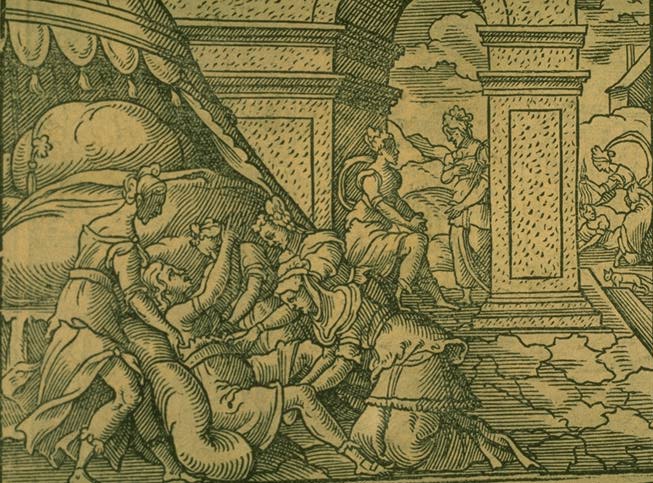

One night stretched into three, and twins with two different fathers
According to the Bibliotheca, Zeus wanted Alcmene before her husband returned, so he ordered the sun god Helios to hold back the dawn, turning one night into three, then arrived at her door disguised as Amphitryon himself. Believing her real husband had come home early, Alcmene listened as he recounted the campaign's victories, in detail he could only have invented, and slept with him. The true Amphitryon arrived the following night, still unaware anything had happened, and slept with his wife as well. The result, as the myth lays it out, is a case of two conceptions within roughly 24 hours producing twin sons with different fathers: Heracles, son of Zeus, and Iphicles, son of Amphitryon. Modern reproductive biology has a name for a genuine version of this outcome in humans, heteropaternal superfecundation, though nothing about the ancient story is framed in those terms; it is presented purely as a god's deception, not a biological curiosity.
Amphitryon learned the truth only when Alcmene, assuming both nights had come from the same man, mentioned the second visit and he realized he had been away for the first. The seer Tiresias confirmed what had actually happened.
Hera's revenge isn't one story. It's three, plus a comedy that skips the suffering entirely
Homer's Iliad gives the oldest surviving account of what came next, and it isn't a curse on Alcmene directly. Zeus announced to the gods that a child of his blood, born that day, would rule all those around him. Hera, forcing Zeus to swear to the boast, rushed to Argos and made the wife of Sthenelus deliver her own son, Eurystheus, a full two months early, while simultaneously delaying Alcmene's labor. The oath stood, but the ruler it named turned out to be Eurystheus rather than Heracles, and it was Eurystheus who later commanded the Twelve Labors.
Ovid's Metamorphoses tells a different, more physical version, set entirely inside Alcmene's birthing room. After seven days of agony, she called on Lucina, goddess of childbirth, who had secretly been ordered by Juno to sit outside with fingers laced and legs crossed, a posture believed to magically seal the womb shut. A servant, Galanthis, noticed the goddess's strange stillness, guessed the trick, and shouted that the child had already been born, startling Lucina into jumping up and breaking her own spell. Alcmene delivered safely the moment the goddess moved; Galanthis was punished by being turned into a weasel, and, according to Ovid, continued to live at Alcmene's side in that form.
Pausanias records a third version from Thebes itself: Hera sent witches to block the delivery, and they were only defeated when Historis, daughter of the seer Tiresias, tricked them the same way Galanthis had, by falsely announcing the birth. A fourth, deliberately lighter version comes from Roman comedy: in Plautus's play Amphitryon, Jupiter simply grants Alcmene a fast, painless birth after a crash of thunder, skipping the suffering altogether, a reminder that even ancient audiences didn't treat this as one fixed, sacred story rather than material different writers reshaped for different purposes.
Her life after Heracles, and a death two cities couldn't agree on
After Amphitryon's death, Alcmene remarried Rhadamanthys, a son of Zeus best known as a judge of the underworld, and lived out her later years with him in exile at Ocaleae in Boeotia. She reappears once more in the myth after Heracles's own death and deification: when his children, the Heracleidae, were hunted by King Eurystheus, her grandson Hyllus killed him and brought her the severed head, which Alcmene reportedly gouged out with weaving pins, a detail that undercuts any reading of her purely as a passive victim of the gods.
Her death itself splits into two competing traditions, and Pausanias, writing in the 2nd century AD, records both without picking a side. The Megarian version holds that she died on the road from Argos to Thebes and was buried at Megara after the Heracleidae, who couldn't agree whether to carry her body to Argos or Thebes, deferred to an oracle from Delphi that named Megara instead; Pausanias says he saw her tomb there himself, near the Olympieum. The Theban version, credited to the earlier poet Pherecydes, is stranger: as her body was being carried to burial, Zeus had Hermes secretly swap it for a stone, and Heracles's sons, discovering the substitution, set the stone up in a sacred grove at Thebes rather than a grave. The Twelve Olympians who ran the wider pantheon left plenty of unresolved contradictions in their own family records, and Alcmene's ending is one more case where two Greek cities each kept the version that let them claim her.